
Why Businesses Are Replacing Traditional IT Hiring with Augmentation
There is a quiet shift happening in the way companies build their technology teams. It does not make headlines the way AI or cloud migration does, but it is reshaping how businesses think about IT talent and for many, it is solving a problem that traditional hiring simply cannot.
That shift is IT staff augmentation. And once you understand why it is growing so fast, the appeal becomes obvious.
The Problem with Traditional IT Hiring
Let us be honest about what conventional IT recruitment actually looks like in practice.
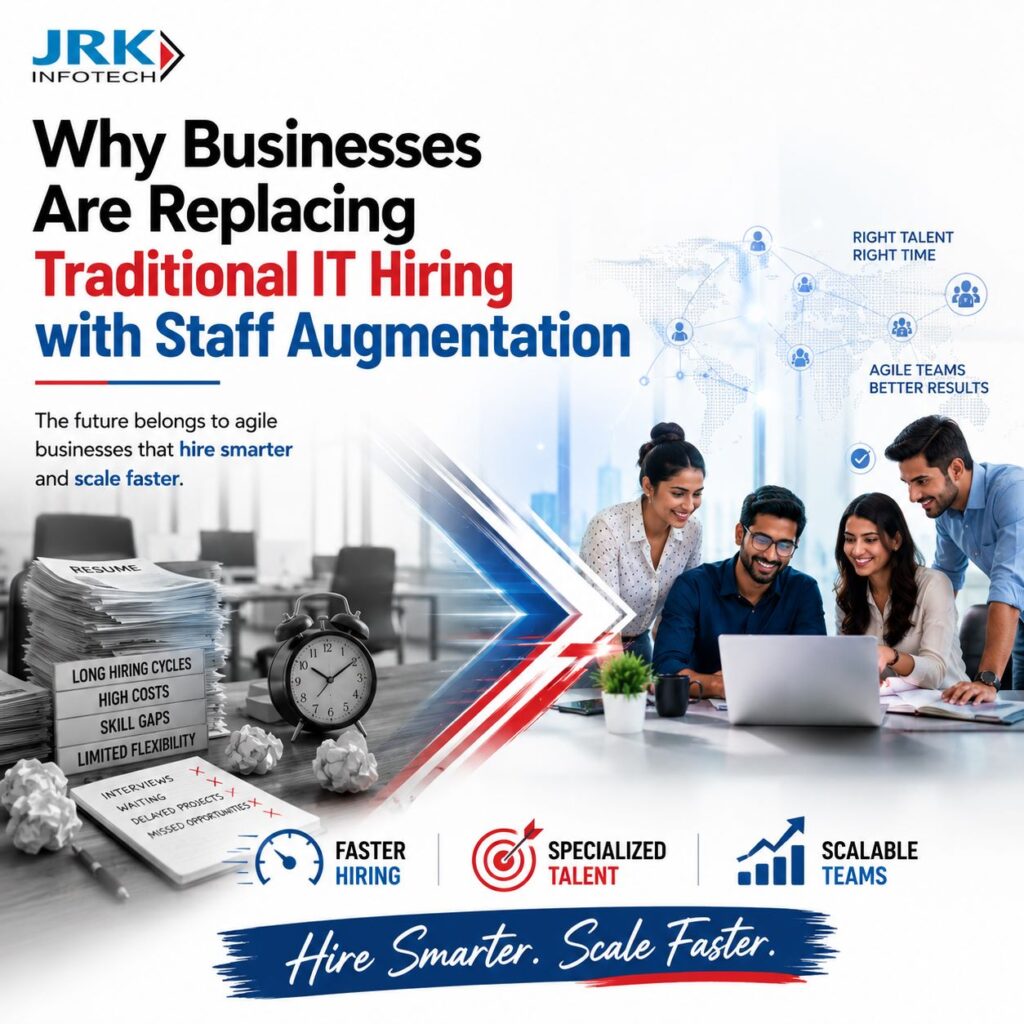
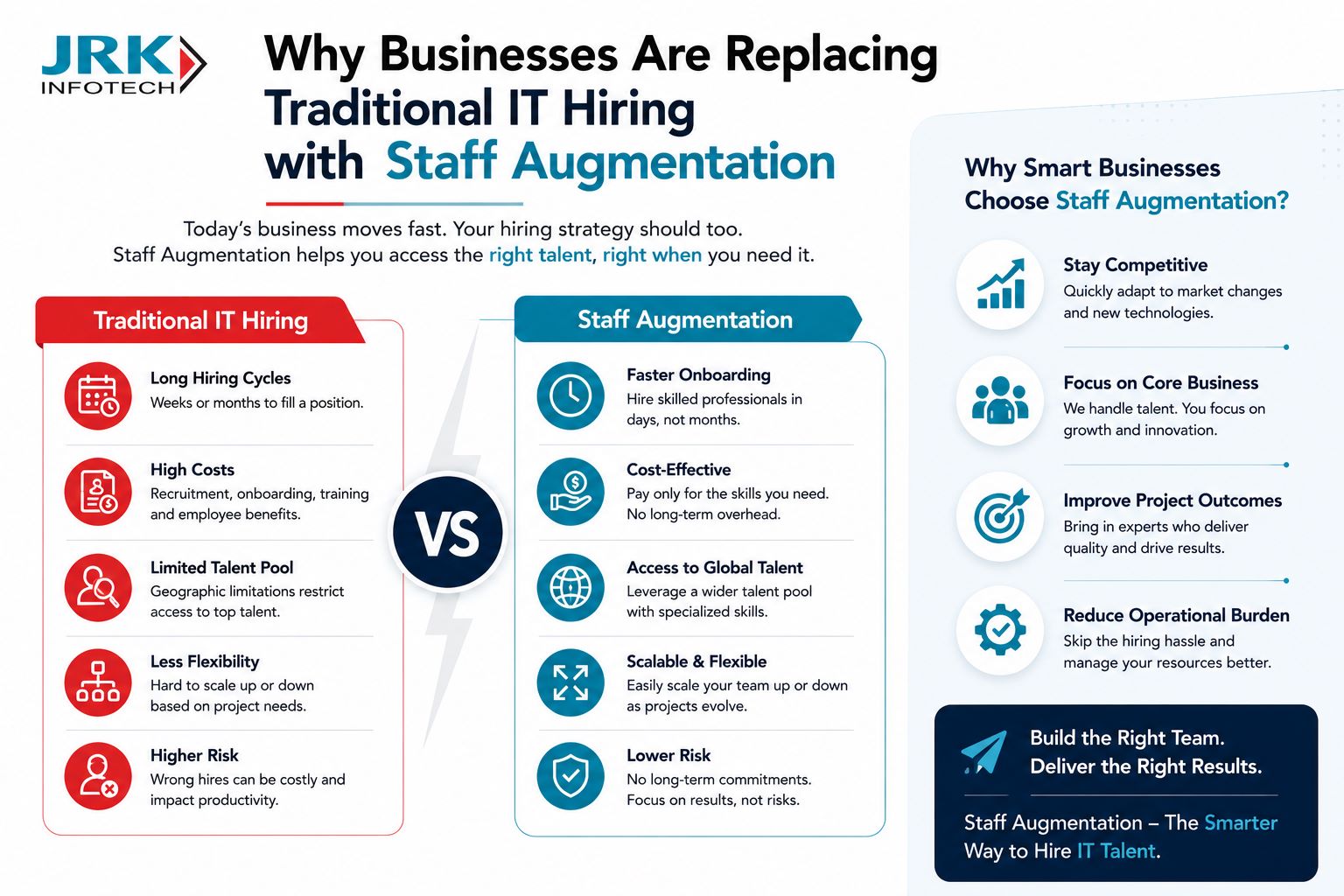
You write a job description. You post it. You wait. Weeks pass. A recruiter sends you CVs that are 80% wrong. You interview a dozen candidates, find two who are good, make an offer to one, and then wait another month while they serve their notice period. By the time your new hire sits down at their desk, three months have gone by and the project they were hired for is already behind schedule.
That is on a good day. On a bad day, they leave after six months and you start again.
The world of technology moves faster than traditional hiring can keep up with. Skills that were cutting-edge two years ago are already being replaced. The demand for good engineers, cybersecurity professionals, data scientists, and cloud architects has never been higher and the supply has never felt tighter. Companies that rely purely on conventional recruitment are, in many cases, fighting a losing battle.
What Is IT Staff Augmentation?
IT staff augmentation is a model where a business brings in external technology professionals developers, engineers, QA testers, architects to work as part of its existing team, under its own management and direction, for a defined period.
These are not freelancers working independently in isolation. They are not an outsourced vendor delivering a finished product from a distance. They are skilled professionals who plug directly into your team, attend your standups, work in your tools, and are accountable to your product or engineering lead.
The key difference from traditional hiring is simple: the augmented professional is employed by a staffing partner, not by you. You get the capability without the commitment.
Why the Model Is Growing So Fast
1. Speed
The average time to hire a senior software engineer through traditional recruitment is between 45 and 90 days. Through an augmentation partner, that same capability can be onboarded in one to two weeks. When a project is waiting, every week matters.
2. Flexibility
Business needs change. A product launch might require six additional developers for four months, after which that capacity is no longer needed. With permanent hires, you either carry that headcount paying salaries for work that is not there or go through the painful and expensive process of letting people go. Augmentation lets you scale up when you need to and scale back down when you do not, without any of that friction.
3. Access to Specialist Skills
Not every business needs a full-time blockchain developer or a machine learning engineer on staff. But many businesses occasionally need exactly those skills for a specific project or phase. Augmentation gives you access to highly specialised talent for precisely as long as you need it without having to build an entire permanent practice around a capability you will use once.
4. Cost Efficiency
Hiring a full-time senior developer in a major city carries a significant cost beyond the salary benefits, equipment, office space, onboarding, management overhead, and the hidden cost of a bad hire. Augmented professionals, particularly those sourced from high-quality talent markets in India, Eastern Europe, or Latin America, can deliver equivalent or superior capability at a significantly lower total cost.
5. Reduced Risk
Hiring the wrong person permanently is expensive and disruptive. A probation period helps but does not eliminate the risk. With augmentation, if a professional is not the right fit, the staffing partner can replace them quickly. The risk sits with the partner, not with you.
How It Differs from Outsourcing
This is the question that comes up most often, and it is worth being clear about it.
Outsourcing means handing a piece of work to an external team and buying a result. You define what you want, they go away and build it, and you receive a deliverable. You are largely hands-off on the how.
Augmentation is different. You are not buying a result you are adding capability to your existing team. The augmented professionals work under your direction, within your processes, using your tools. You manage them. You set the priorities. You own the output.
Think of it this way: outsourcing is hiring a contractor to renovate your kitchen. Augmentation is hiring a skilled tradesperson to work alongside your existing team, following your plans, under your supervision.
Both have their place. But for businesses that want to maintain control of their technology roadmap while accessing external talent, augmentation is the more natural fit.
What the HR Function Gets Wrong About Augmentation
Many HR teams still treat staff augmentation as a purely procurement exercise a line item to be negotiated down to the lowest day rate. This misses the point entirely.
The value of augmentation is not in finding the cheapest engineer. It is in finding the right engineer, fast, with minimal friction, in a model that gives the business flexibility it would never have with a permanent hire. HR teams that understand this approach augmentation the way they approach strategic hiring with attention to cultural fit, communication skills, and long-term potential and they get dramatically better results.
The businesses that use augmentation most effectively treat their augmented professionals as genuine team members, not temporary bodies. They invest in onboarding them properly, include them in team rituals, and give them the context they need to do their best work. The ones who treat augmented staff as interchangeable contractors tend to get interchangeable results.
When Augmentation Is the Right Choice
IT staff augmentation is not the answer to every situation. It works best when:
You have a defined short-to-medium term need. A product launch, a technology migration, a backlog clearance, a new feature build — these are ideal augmentation scenarios. The work is real, the timeline is clear, and the need has a natural end point.
You have internal leadership capacity. Augmentation works when you have someone internally a CTO, a product manager, a tech lead — who can direct and manage the augmented resource. Without that, you end up with capable people pointing in the wrong direction.
Speed matters more than permanence. If you need capability now rather than in three months, augmentation is almost always faster than traditional recruitment.
You need specialist skills you do not want to build internally. Niche technical skills that are needed for a phase of work but not permanently are a natural fit for augmentation.
When It Is Not the Right Choice
Augmentation is not ideal when the work requires deep, sustained institutional knowledge that only comes from years inside the business. Core product strategy, long-term architecture decisions, and roles that touch sensitive business data or IP may be better served by permanent hires who are fully committed to the organisation.
It also does not work well when there is no internal management capacity to direct the augmented resource. Without clear ownership, even excellent external talent will struggle to deliver.
The Future of IT Talent Looks Hybrid
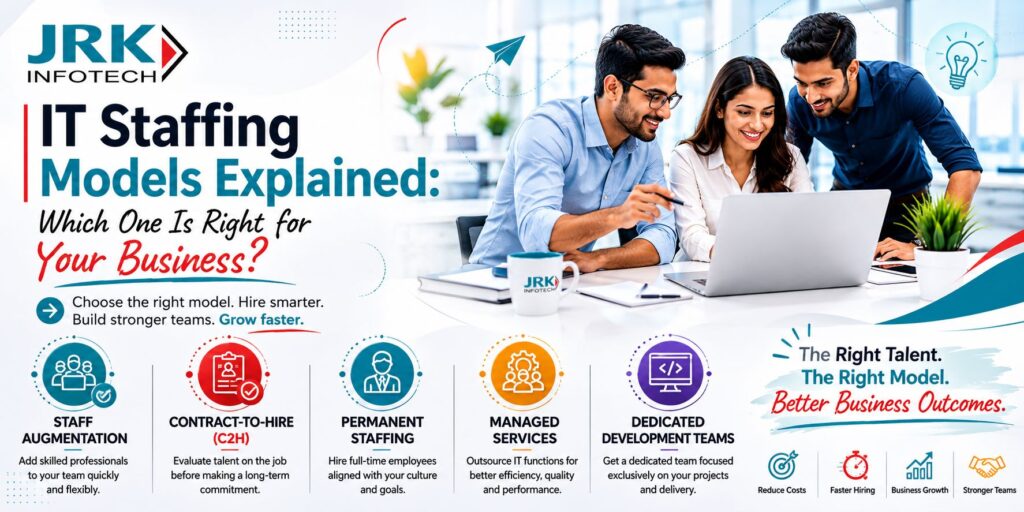
The most forward-thinking technology organisations are not asking “should we hire permanently or augment?” They are building hybrid models that use both strategically.
A small, senior, permanent core team sets the direction, owns the architecture, and maintains institutional knowledge. Around that core, a flexible layer of augmented talent scales up and down based on what the roadmap demands. Managed services handle the operational layer infrastructure, security, support freeing everyone else to focus on building.
This model gives businesses the agility of a startup and the stability of an enterprise. It is not the future of IT hiring. It is the present and the companies that have not figured this out yet are already feeling the gap.
Frequently Asked Questions
What is IT HR augmentation? IT HR augmentation is a staffing strategy where businesses bring in external IT professionals developers, engineers, architects, QA testers to work as integrated members of their existing team, under their own management, for a defined period. The professionals are employed by a staffing partner but work directly within the client’s processes and tools.
How is IT augmentation different from outsourcing? Outsourcing hands a defined piece of work to an external team who delivers a finished result. Augmentation adds skilled professionals directly into your existing team, working under your direction and management. With augmentation, you retain full control of the work; with outsourcing, you buy a deliverable.
How quickly can an augmented IT professional start? Most augmentation partners can place a qualified professional within one to two weeks compared to 45 to 90 days for a traditional permanent hire. Speed is one of the primary reasons businesses choose augmentation.
Is IT staff augmentation cost-effective? Yes, when used correctly. While day rates for augmented professionals may appear higher than equivalent salaries, the total cost of augmentation is typically lower when you factor in recruitment fees, benefits, equipment, onboarding time, and the risk cost of a bad permanent hire. Offshore augmentation from markets like India or Eastern Europe can reduce costs further while maintaining high quality.
What types of IT roles are best suited to augmentation? Software developers, QA engineers, DevOps engineers, cloud architects, cybersecurity specialists, data engineers, and UX designers are among the most commonly augmented IT roles. Specialist or niche skills that are needed for a project phase but not permanently are particularly well suited to this model.
Does augmentation work for long-term projects? Yes. While augmentation is often associated with short-term needs, many businesses maintain augmented professionals for 12 to 24 months or longer on extended product development programmes. The key advantage over permanent hiring remains flexibility to scale the team up or down as project demands change.
What should HR teams look for in an IT augmentation partner? Look for a partner with a strong talent pipeline in the specific technology skills you need, a transparent vetting process, clear contract terms, fast replacement guarantees if a professional is not the right fit, and experience working with businesses of your size and in your industry.
Can augmented IT staff work remotely? Yes the majority of augmented IT professionals work remotely, which is one of the reasons the model has grown so significantly since 2020. Remote augmentation opens access to global talent pools and is now standard practice across the industry.