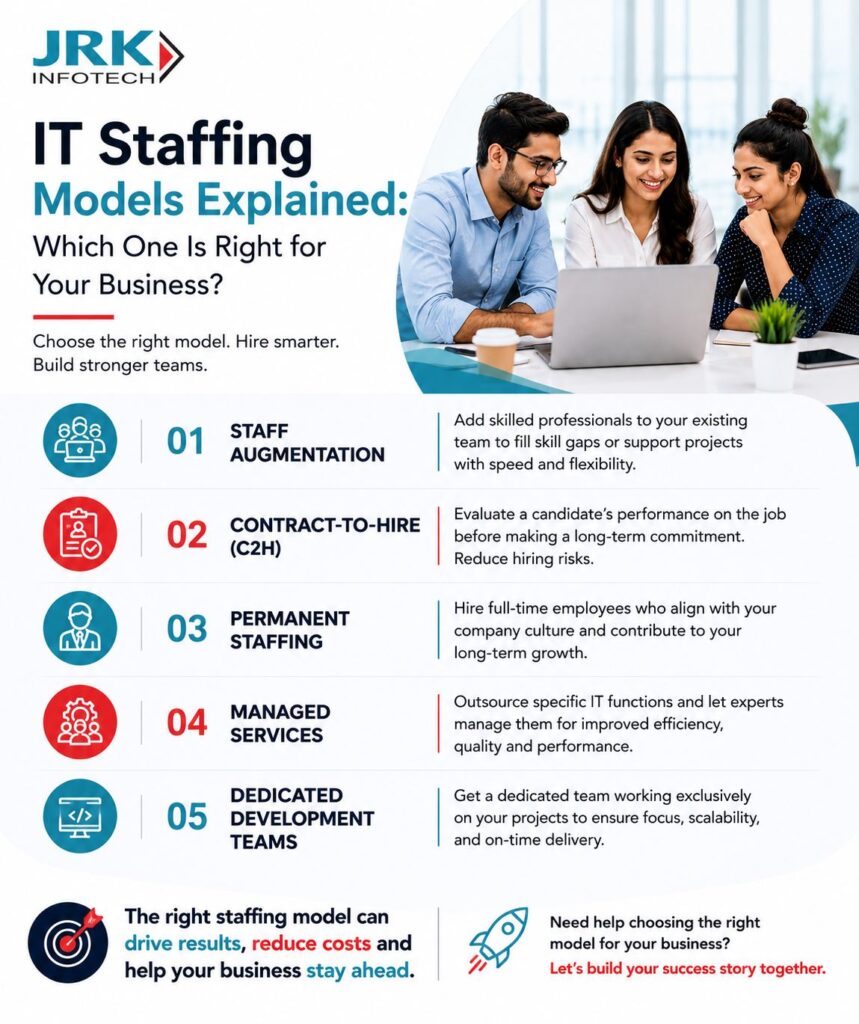

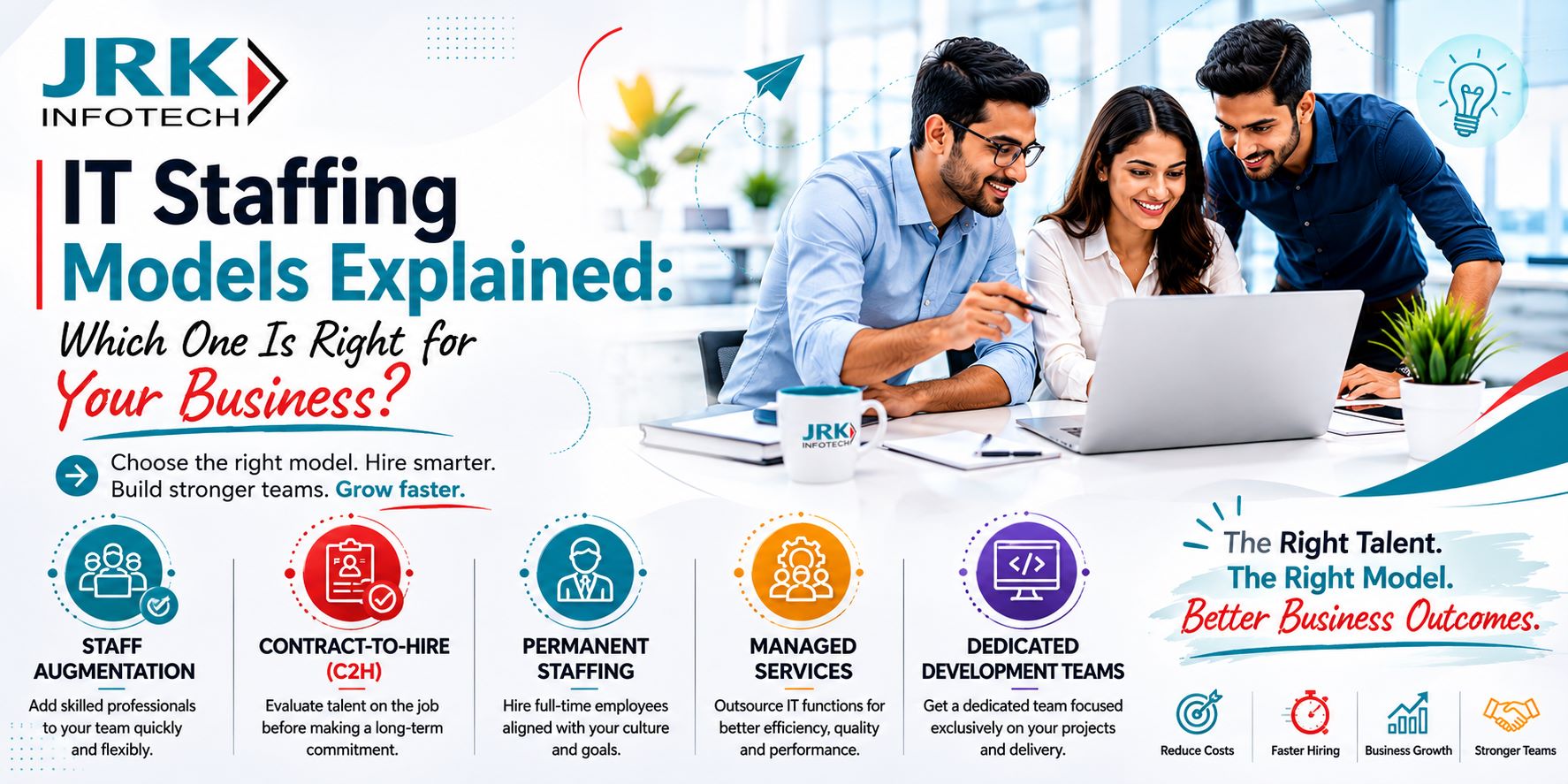
IT Staffing Models Explained: Which One Is Right for Your Business?
Hiring the right IT talent is hard enough. Choosing the wrong staffing model on top of that? That can quietly drain your budget, slow your projects, and leave your team frustrated for months before anyone figures out what went wrong.
The truth is, there is no single “best” IT staffing model. What works brilliantly for a fast-moving startup launching its first product can be a complete disaster for an enterprise running a decade-old ERP system. Context matters enormously here — and yet most businesses pick a model based on habit, or because it is what their last vendor offered, rather than what their situation actually calls for.
This guide breaks down every major IT staffing model in plain language, with honest pros and cons, so you can make the decision with your eyes open.
First, Why Does the Staffing Model Matter So Much?
Most people focus on the “who” of hiring skills, experience, cultural fit. Those things matter, but the “how” of hiring shapes almost everything else: cost predictability, team cohesion, speed of delivery, IP ownership, and your ability to scale up or down when business conditions change.
Get the model wrong and even a team of brilliant engineers can feel like the wrong hire. Get it right and average talent can punch well above its weight.
The 6 Main IT Staffing Models
1. In-House (Full-Time Employees)
This is the traditional model. You hire engineers, developers, or IT professionals directly onto your payroll. They work exclusively for you, sit in your office or on your Slack, and are fully embedded in your company culture.
When it works well: When you have ongoing, long-term technology needs that require deep institutional knowledge think a product company that ships continuously, or a business where IT is a core competitive advantage rather than a support function.
The honest downside: It is expensive and slow. Between salary, benefits, equipment, onboarding, and the time it takes to find the right person, a single senior developer hire can take three to four months and cost significantly more than the sticker salary suggests. And if your needs shrink, you are left carrying headcount you do not need.
Best for: Product companies, tech-first businesses, organisations where IT sits at the heart of the business model.
2. Staff Augmentation
Staff augmentation means bringing in external IT professionals to work alongside your existing team temporarily filling skill gaps or adding capacity for a specific period. These people work within your processes, under your direction, but they are employed by a staffing agency or vendor.
Think of it as renting talent. You plug someone into your team for three months, they help you ship a feature or clear a backlog, and then they leave when the work is done.
When it works well: When you have a clear short-term need a product launch, a technology migration, a seasonal demand spike and your internal team has the leadership capacity to manage the additional resource.
The honest downside: Knowledge walks out the door when the contract ends. If you are not deliberate about documentation and knowledge transfer, you can find yourself six months later with a system nobody fully understands. There is also a real risk of misalignment if the augmented staff feel like outsiders rather than genuine team members.
Best for: Businesses with a strong internal IT team that needs temporary capacity, not long-term structure.
3. Dedicated Development Team
A dedicated team model means you contract an external vendor to provide a full team developers, QA engineers, a project manager, sometimes a designer who work exclusively on your project, full-time, over an extended period. They are effectively your team, just employed by someone else.
This is the model that has exploded in popularity over the last decade, largely because of the quality of engineering talent available in Eastern Europe, India, and Latin America at a fraction of the cost of equivalent Western hires.
When it works well: When you need a full-team capability but do not want the overhead of building one from scratch. It is particularly powerful for startups that need to move fast, and for mid-sized businesses that want to build a digital product without hiring a whole engineering department.
The honest downside: It requires real management investment on your side. A dedicated team is not a set-it-and-forget-it solution. Without strong product ownership and clear communication from your end, even the best external team will struggle. Time zone differences can also create friction if not managed proactively.
Best for: Startups, product development projects, businesses that want to build long-term digital capability without the full overhead of in-house hiring.
4. Project-Based / Fixed-Price Model
Here you hand a defined scope of work to an external vendor and agree on a fixed price and timeline upfront. The vendor is responsible for delivery you are buying an outcome, not hours.
This sounds appealing because it feels low-risk. You know exactly what you are getting and exactly what you are paying. In practice, it is more complicated than that.
When it works well: When the project scope is genuinely clear, stable, and unlikely to change. A simple website redesign, a well-defined integration, or a clearly scoped mobile app can work well on a fixed-price basis.
The honest downside: Most technology projects are not actually well-defined upfront. Requirements change. Stakeholders change their minds. New constraints emerge. On a fixed-price contract, any change to scope triggers a change order, which means negotiation, delay, and usually extra cost. Vendors also price in a risk buffer so the fixed price is rarely the cheapest way to get the work done.
Best for: Well-defined, stable-scope projects where the business requirements are locked in before development begins.
5. Time and Material (T&M)
The opposite of fixed-price. You pay for actual hours worked at agreed rates, and the scope can evolve as the project progresses. There is no fixed end point or fixed cost you are paying for the journey, not a destination.
When it works well: When you are building something innovative, exploring new technology, or working in an environment where requirements are likely to shift. Agile product development is almost always better suited to a T&M model because it gives you the flexibility to change direction based on what you learn.
The honest downside: Without discipline on scope and velocity, costs can spiral. T&M contracts require strong project governance on your end you need to know what you are getting for your money and have the visibility to course-correct when things drift.
Best for: Complex, evolving projects, R&D work, agile product development, anything where flexibility matters more than cost certainty.
6. Managed Services
With managed services, you outsource the ongoing management and operation of specific IT functions infrastructure, cybersecurity, helpdesk, cloud management to a third-party provider. You pay a monthly fee and the provider is responsible for keeping things running to agreed service levels.
This is less about building software and more about running technology reliably. Managed service providers (MSPs) are the people who make sure your systems stay up, your data stays backed up, and your employees can get IT support when something breaks.
When it works well: When IT operations are a necessity rather than a differentiator. If keeping the lights on is more important to you than building cutting-edge technology, managed services let you do that cost-effectively without maintaining a large internal IT operations team.
The honest downside: You give up a degree of control and visibility. If the MSP has a bad month, your business feels it. Contract terms and SLAs need to be carefully negotiated upfront, because a poorly written managed services agreement can leave you with very little recourse when things go wrong.
Best for: Small to mid-sized businesses that need reliable IT operations without the cost of a full in-house IT department.
How to Choose the Right Model
The honest answer is that most mature businesses use a combination of models rather than picking just one. They might keep a small in-house team for product strategy and architecture, use staff augmentation for peak periods, and rely on managed services for infrastructure.
But if you are starting from scratch, here are three questions that will point you in the right direction:
How well-defined is your scope? Clear, stable scope → Fixed price. Evolving or complex scope → T&M or dedicated team.
How long is the need? Short-term, specific gap → Staff augmentation. Long-term, ongoing capability → In-house or dedicated team.
Is IT a core part of your business or a support function? Core differentiator → In-house or dedicated team with strong ownership. Support function → Managed services or augmentation.
The Mistake Most Businesses Make
The most common mistake is treating IT staffing as a pure cost decision. Businesses go for the cheapest option, which often means a fixed-price contract with a low-cost vendor, and then spend the next year managing a difficult relationship, mediocre output, and ballooning change orders that erase any initial savings.
The right model is the one that aligns with how your business actually works its pace, its culture, its level of internal technical maturity, and its appetite for risk. Spend time getting that alignment right before you worry about the hourly rate.
Frequently Asked Questions
What is an IT staffing model? An IT staffing model is the arrangement a business uses to source, hire, and manage technology talent. It defines whether IT professionals are full-time employees, contractors, part of an outsourced team, or managed by a third-party provider and it shapes how work is structured, priced, and delivered.
What is the difference between staff augmentation and a dedicated team? Staff augmentation adds individual contractors to an existing in-house team to fill specific skill gaps, usually for a short period. A dedicated team model provides a complete, self-contained team developers, QA, project management that works exclusively on your project over a longer period. Augmentation supplements your team; a dedicated team replaces the need to build one internally.
Which IT staffing model is cheapest? On paper, staff augmentation and offshore dedicated teams tend to offer the lowest hourly rates. But cheapest upfront is not always cheapest overall. Fixed-price contracts often include vendor risk buffers that inflate the total cost. In-house hiring carries high overheads beyond salary. The most cost-effective model depends on your project duration, complexity, and internal management capacity not the hourly rate alone.
When should a startup use a dedicated development team instead of hiring in-house? A startup should consider a dedicated team when it needs to move fast, lacks the time or runway to run a full hiring process, or wants to access senior engineering talent without committing to permanent headcount. Dedicated teams allow a startup to scale up quickly, reduce risk, and shift course if the product strategy changes none of which are easy with full-time hires.
What is the biggest risk of outsourcing IT on a fixed-price contract? The biggest risk is scope creep. Most technology projects evolve as development progresses requirements change, new priorities emerge, and stakeholders see things differently once a product takes shape. On a fixed-price contract, every change triggers a renegotiation and a change order. This slows delivery, creates tension with the vendor, and often results in a final cost well above the original quote.
Can a business use more than one IT staffing model at the same time? Absolutely and most mature technology organisations do. A common setup is a small in-house team handling product strategy and architecture, a dedicated offshore team doing the bulk of development, and a managed services provider running infrastructure and security. The key is clarity about who owns what, with clean handoffs and governance between each model.
What is IT managed services and how is it different from outsourcing? Managed services is a form of outsourcing, but with a specific focus on ongoing operations rather than project delivery. An outsourcing arrangement typically covers a defined piece of work with a start and end point. A managed services agreement covers the continuous management of IT functions helpdesk, cloud infrastructure, cybersecurity under agreed service levels, usually on a monthly retainer. You are buying reliability and uptime, not a deliverable.
How do I know when it is time to switch IT staffing models? The clearest signals are: costs are rising without proportional output, the team lacks ownership or accountability, your needs have grown beyond what the current model supports, or the relationship with your vendor has become adversarial. A staffing model should be reviewed at least annually or any time the business undergoes significant growth, a product pivot, or a change in technology strategy.