

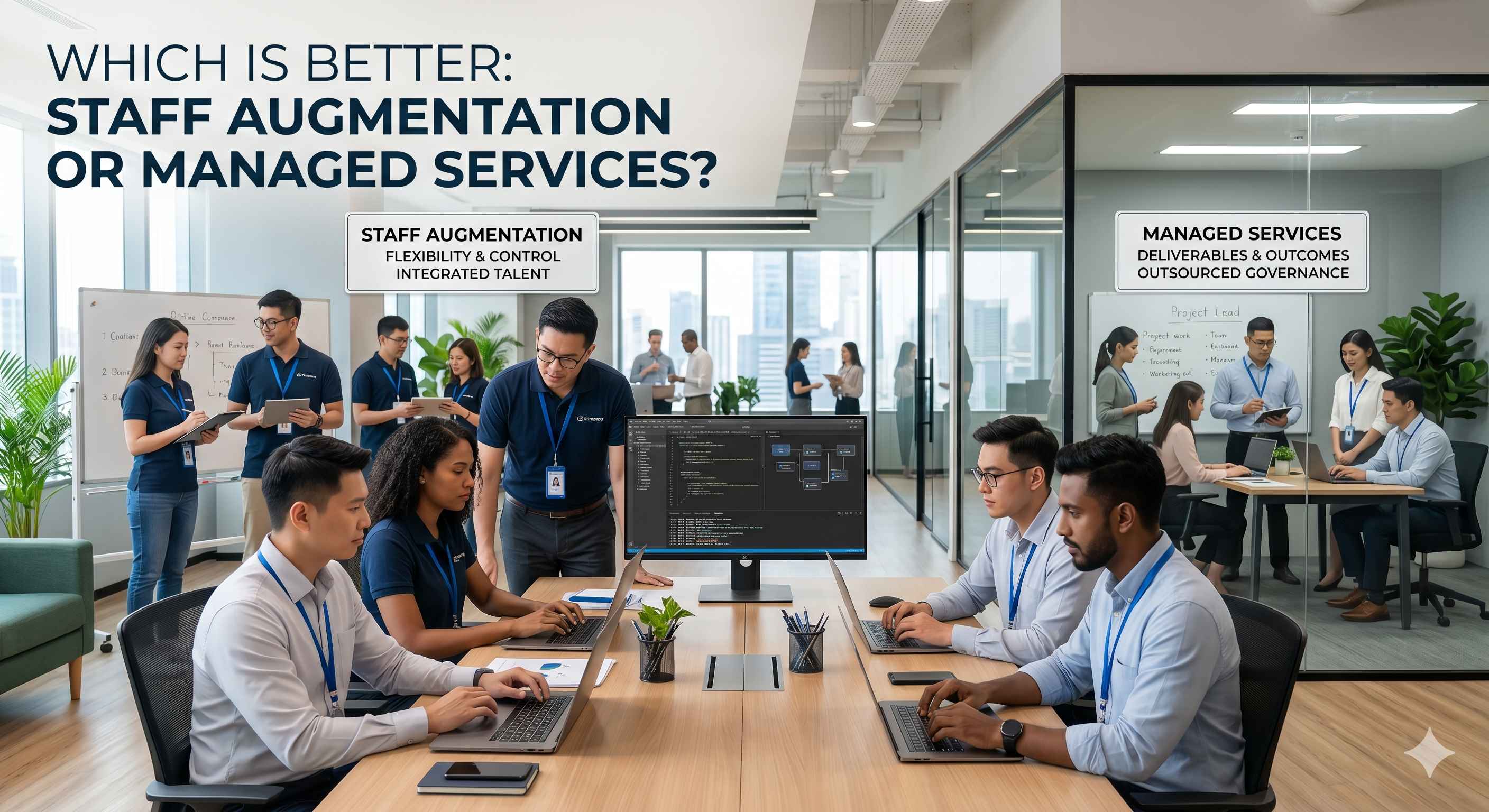
Which is Better: Staff Augmentation or Managed Services?
In today’s fast-paced business world, finding the right talent and operational support can feel like navigating a maze. You need expertise, flexibility, and efficiency, but how do you get it without breaking the bank or stretching your internal team too thin? Two popular strategies often come to the forefront: Staff Augmentation and Managed Services.
Both offer powerful ways to enhance your capabilities, but they operate on fundamentally different principles. So, which one is “better” for your business? The truth is, there’s no universal answer. It all depends on your specific needs, goals, and resources. Let’s break down each model to help you make an informed decision.
Understanding Staff Augmentation
Imagine you have a fantastic internal team, but they’re missing a very specific skill for a crucial project – say, a niche cybersecurity expert or a React Native developer for a few months. That’s where staff augmentation shines.
What is Staff Augmentation?
Staff augmentation involves integrating external talent directly into your existing in-house team on a temporary or project-specific basis. These augmented staff members work under your management, using your processes and tools, just like a regular employee, but they remain employed by the staffing agency.
Pros of Staff Augmentation
- Direct Control: You maintain full control over the augmented staff’s daily tasks, project direction, and workflow. They become an extension of your team.
- Specific Skill Gaps: It’s ideal for filling very particular skill gaps without the commitment of a full-time hire.
- Knowledge Transfer: Your existing team can learn directly from the augmented staff, fostering internal growth and upskilling.
- Flexibility & Scalability: Easily scale your team up or down based on project demands, without the complexities of hiring and firing.
- Cultural Fit: You have a say in selecting individuals who align with your company culture.
Cons of Staff Augmentation
- Management Overhead: You’re responsible for managing the augmented staff, which adds to your internal team’s workload.
- Integration Challenges: Integrating external personnel can sometimes lead to onboarding challenges or cultural friction if not managed well.
- Limited Scope: It’s often best for specific roles or tasks, not for offloading entire functions.
- Potential for Vendor Dependency (for specific talent): If you rely heavily on one augmented individual, their departure can create a new gap.
Understanding Managed Services
Now, let’s consider a different scenario. You need your IT infrastructure managed 24/7, your customer support handled outside of business hours, or a complex software development project delivered end-to-end. You don’t necessarily want to manage the individual people doing the work, just the outcome. Enter Managed Services.
What are Managed Services?
Managed services involve outsourcing a specific function, project, or set of responsibilities to a third-party provider. This provider takes full ownership of delivering that service, managing their own team, processes, and technology to meet agreed-upon service level agreements (SLAs). You’re buying a service or an outcome, not individual people.
Pros of Managed Services
- Reduced Operational Burden: The provider handles all management, staffing, and operational aspects of the outsourced function, freeing up your internal resources.
- Specialized Expertise & Best Practices: Managed service providers (MSPs) specialize in their domain, bringing deep expertise, established processes, and cutting-edge tools that your internal team might lack.
- Predictable Costs: Often structured with fixed monthly fees, allowing for better budget forecasting.
- Focus on Core Business: By offloading non-core functions, your internal team can concentrate on strategic initiatives that drive your business forward.
- Scalability & Reliability: MSPs are designed to scale and provide continuous service, often with built-in redundancy and support.
Cons of Managed Services
- Less Direct Control: You hand over operational control to the provider. While you define the outcomes, you don’t manage the day-to-day execution.
- Potential Communication Gaps: Effective communication and clear SLAs are crucial to avoid misunderstandings.
- Vendor Dependency: Switching providers can be complex, and you become reliant on their performance.
- Potential for Misalignment: If the provider doesn’t fully grasp your business context, the service might not perfectly align with evolving needs without careful oversight.
Key Differences at a Glance
| Feature | Staff Augmentation | Managed Services |
|---|---|---|
| Control | High (you manage the staff) | Low (provider manages the staff and process) |
| Responsibility | You (for project success, daily tasks) | Provider (for service delivery, SLAs, outcomes) |
| Focus | Filling skill gaps, adding capacity | Outsourcing an entire function or project |
| Cost Structure | Time & material (per person, per hour/day) | Fixed fee (per service, per month/project) |
| Integration | External staff integrates into your team | Provider operates independently |
| Risk | Shared (you manage performance) | Primarily with provider (they’re accountable for outcome) |
| Best For | Short-term projects, specific skill needs | Long-term functions, complex projects, operational relief |
When to Choose Staff Augmentation
Consider staff augmentation if:
- You have a well-defined project with clear requirements but lack specific skills internally.
- You want to maintain full control over project direction, intellectual property, and daily operations.
- Your existing team needs temporary capacity boost during peak times or for a limited-duration project.
- You want to foster knowledge transfer and upskill your internal team by working alongside external experts.
- You have strong internal management capabilities to oversee external personnel.
When to Choose Managed Services
Opt for managed services if:
- You need to offload an entire function or process (e.g., IT support, cybersecurity, payroll, software development lifecycle).
- You lack the internal expertise or resources to manage a complex area effectively.
- You want predictable costs and a clear focus on outcomes rather than managing individual inputs.
- You need to free up your internal team to concentrate on core business activities and strategic growth.
- You require 24/7 support or specialized infrastructure that is expensive or difficult to maintain in-house.
Making Your Decision: A Few Questions to Ask
To determine which model is truly “better” for your situation, ask yourself:
- How much control do I need over the day-to-day work? If it’s high, lean towards staff augmentation.
- What is my internal team’s capacity for management? If it’s limited, managed services might be better.
- Am I looking to fill a specific skill gap or outsource an entire function? Skill gap points to augmentation; function outsourcing points to managed services.
- What’s my budget structure – flexible per-person or predictable fixed costs?
- How critical is this function to my core business, and how much risk am I willing to transfer?
- What’s the project’s nature and expected duration? Short-term, specific needs often suit augmentation; ongoing, complex needs often suit managed services.
requently Asked Questions (FAQs)
1. Can I use both Staff Augmentation and Managed Services at the same time?
Absolutely. In fact, this is the standard operating procedure for mature IT departments in 2026. A company might use managed services to handle their baseline cloud infrastructure and 24/7 security monitoring, while simultaneously using staff augmentation to drop three specialized Python engineers into an active, fast-paced product development sprint.
2. Which model is generally cheaper?
It depends on how you measure cost. Staff augmentation often looks cheaper on paper because you are just paying an hourly rate for a resource. However, that doesn’t account for the “hidden” costs of your internal managers spending hours onboarding, managing, and QAing their work. For long-term, stable needs, managed services usually offer a better total cost of ownership (TCO) because of the fixed, predictable pricing.
3. Does Staff Augmentation work for remote or global teams?
Yes. Global staff augmentation (often called nearshoring or offshoring) is highly effective. You can augment your local team with talent from global tech hubs to reduce costs, provided you have strong communication channels and overlap in working hours to maintain team cohesion.
4. What happens if an augmented staff member isn’t performing well?
This is a major benefit of staff augmentation. If a contractor isn’t a good fit technically or culturally, you simply notify your staffing partner. They will typically swap the resource out for a better fit within a matter of days, avoiding the messy and legally complex termination processes associated with full-time employees.
5. How do SLAs work in Managed Services?
A Service Level Agreement (SLA) is the contractual backbone of a managed services partnership. It outlines exactly what the provider must deliver (e.g., 99.9% server uptime, answering support tickets within 15 minutes, or zero critical security breaches). If the provider fails to meet these metrics, the SLA usually dictates financial penalties or service credits that the provider owes to you.