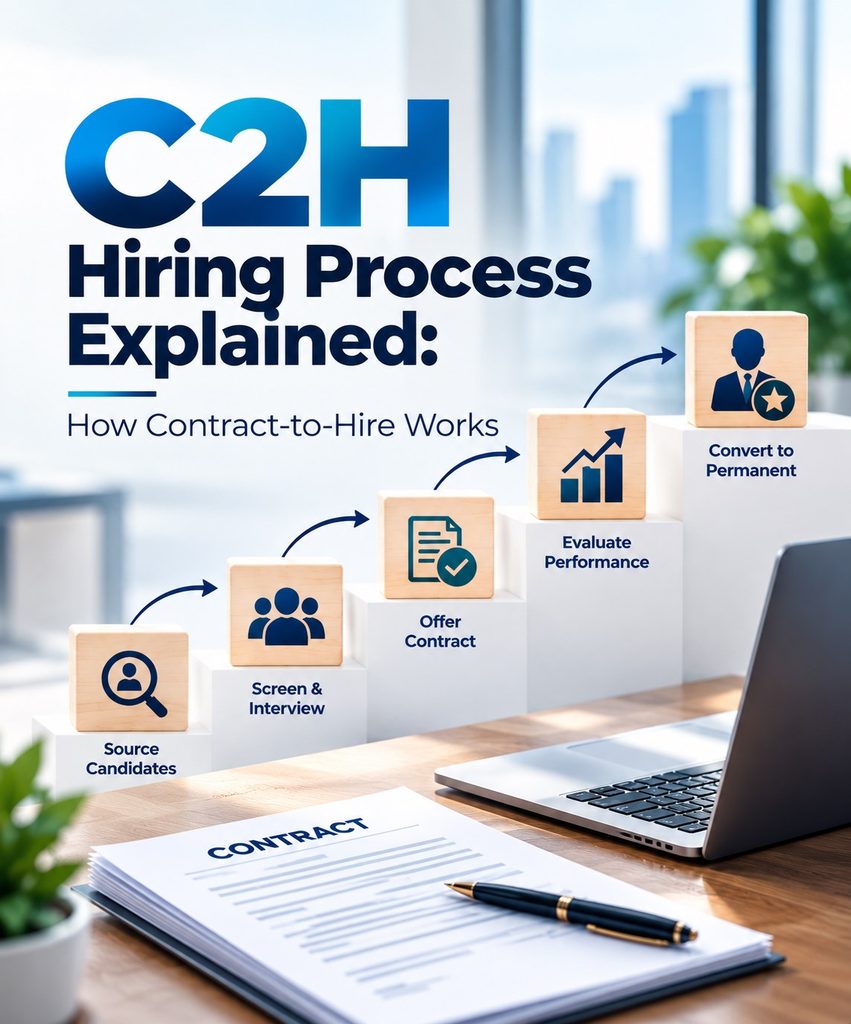

C2H Hiring Process Explained: How Contract-to-Hire Works
Hiring the right employee is about more than finding someone with an impressive résumé. A candidate may perform well in an interview but still struggle with real project requirements, team collaboration, or the pace of the workplace. For businesses hiring IT professionals, these gaps can lead to delays, additional recruitment costs, and repeated hiring efforts.
This is one reason many organisations consider C2H hiring, also known as Contract-to-Hire hiring. It allows a company to bring a professional on board for an agreed contract period, evaluate their performance in a real working environment, and consider them for permanent employment later.
For employers, this model offers more time to assess a candidate before making a long-term commitment. For job seekers, it provides an opportunity to understand the role, team, and company culture before accepting a permanent position.
But how does the C2H hiring process actually work? What happens during the contract period, and what should both employers and candidates know before getting started?
Let’s explore the process step by step.
What Is C2H Hiring?
C2H stands for Contract-to-Hire. It is a hiring arrangement in which a professional initially works under a fixed-term contract, with the possibility of moving into a permanent position if both the employer and the candidate agree.
Unlike direct hiring, where a candidate joins as a permanent employee from the beginning, C2H creates a defined period for evaluating the working relationship.
For example, a company needs a Java developer for an important software project. The candidate has the required technical knowledge, but the company also wants to assess their problem-solving ability, communication, and collaboration with its existing development team.
The company hires the developer through a C2H arrangement for an agreed period. During that time, the developer works on actual project tasks, participates in team discussions, and receives feedback. At the end of the contract, the company can offer permanent employment, extend the arrangement where permitted and agreed, or conclude the engagement according to the contract terms.
One important point: Contract-to-hire does not automatically guarantee a permanent job. Conversion depends on the agreed terms, the candidate’s performance, business requirements, and the willingness of both parties to continue.
How Does the C2H Hiring Process Work?
The C2H recruitment process generally follows six stages. The exact steps can vary depending on the staffing partner, job role, and company’s hiring policy.
1. Identify the Hiring Requirement
The process begins when a business identifies a staffing need.
Perhaps a software development project requires additional engineers, a company needs a cloud specialist, or an organisation wants to fill a position while permanent headcount approval is pending.
Before starting recruitment, the hiring team should define:
- The job responsibilities and expected deliverables.
- Required technical skills and relevant experience.
- The contract duration and proposed joining date.
- The compensation or billing budget.
- The possibility and conditions of permanent conversion.
Clear requirements help the recruiter find candidates who can contribute to the project rather than simply match a list of keywords.
2. Partner With a C2H Recruitment or Staffing Company
Once the requirement is clear, the employer may work with an IT staffing company to source suitable professionals.
A staffing partner can help identify candidates, review their experience, conduct initial screening, coordinate interviews, and support onboarding. Depending on the arrangement, it may also manage contract documentation, payroll, and applicable employment compliance during the contract period.
Choosing the right staffing partner matters. A good partner should understand the technical requirements, communicate honestly with candidates, and explain the commercial terms before the engagement begins.
Employers should confirm the responsibilities of the staffing provider and their own organisation in the written agreement.
3. Source, Screen, and Interview Candidates
The recruiter searches for candidates whose skills and experience align with the role. The screening process may include résumé evaluation, technical assessments, employment-history checks, and an initial discussion about availability and compensation.
Shortlisted candidates then meet the hiring team.
For an IT role, the interview might cover coding skills, system design, debugging, or experience with a specific technology stack. The employer should also evaluate how the candidate approaches problems, communicates with colleagues, and responds to feedback.
The C2H model should not be an excuse to reduce screening standards. A thoughtful selection process helps both sides start with realistic expectations.
4. Finalise the Contract and Complete Onboarding
After selecting a candidate, the parties agree on the terms of the engagement before work begins.
These terms may cover:
- Contract duration and start date.
- Salary or agreed compensation.
- Notice period and early termination conditions.
- Working hours, location, and reporting arrangements.
- Leave, benefits, and payroll responsibilities.
- Confidentiality, data security, and intellectual property.
- Performance expectations and the process for considering permanent employment.
Where a staffing agency employs the professional during the contract period, the agency generally manages the employment paperwork and payroll under the agreed arrangement. The client company typically manages day-to-day work and project priorities.
The actual responsibilities depend on the contract structure, so employers and candidates should review the documents rather than assume every C2H role works the same way.
Once the necessary paperwork and access arrangements are complete, the professional can join the team.
5. Evaluate Performance During the Contract Period
This is the most important stage of the C2H hiring process.
Instead of relying only on interview responses, the employer can evaluate how the professional performs in real working conditions.
For example, a software developer may be assessed on code quality, delivery against agreed deadlines, debugging skills, documentation, and collaboration with other developers. A cloud engineer may be evaluated on deployment practices, infrastructure reliability, security awareness, and incident response.
A useful evaluation process includes:
Clear goals: Define what the employee is expected to deliver and by when.
Regular feedback: Discuss progress throughout the contract instead of waiting until the final week.
Technical and behavioural assessment: Consider both job-specific skills and the ability to work effectively with the team.
Two-way communication: Give the candidate an opportunity to raise concerns about workload, tools, management, or the role itself.
The candidate is also evaluating the employer. They can learn whether the responsibilities match the original description, whether the team provides adequate support, and whether the company is a place where they want to build a long-term career.
6. Decide Whether to Convert the Candidate to Permanent Employment
As the contract approaches its end, the employer and candidate should discuss the next step.
There are generally three possible outcomes.
Permanent conversion: If the candidate meets expectations and both sides agree, the company makes a permanent employment offer. The parties complete the necessary documentation and payroll transition.
Contract extension: If more time is needed and the contract terms allow it, the parties may agree to extend the engagement. Any changes should be documented clearly.
End of engagement: If the role is no longer required, the candidate does not meet the agreed requirements, or either party chooses not to continue, the engagement ends according to the contract terms.
Employers should begin the conversion discussion before the final contract date. Early communication gives everyone time to consider the decision and complete the required paperwork.
How Long Does a C2H Contract Usually Last?
There is no single duration for every contract-to-hire position. A C2H arrangement may last three, six, or twelve months, depending on the job, the complexity of the work, the employer’s requirements, and the agreement between the parties.
For example, a developer working on a clearly defined project may need a shorter evaluation period than a specialist responsible for complex enterprise infrastructure.
The contract duration should provide enough time to assess meaningful performance without creating unnecessary uncertainty for the candidate.
Employers should also communicate the expected conversion timeline clearly. Candidates should not be led to believe that permanent employment is guaranteed when the company has not made that commitment.
Key Benefits of C2H Hiring for Employers
Evaluate skills through real work
Interviews can establish whether someone understands a technology, but day-to-day work reveals how they apply that knowledge. C2H gives employers a broader view of technical ability, productivity, and collaboration.
Add talent with greater flexibility
Businesses can bring in professionals for current project needs while evaluating whether the role should become a long-term position. This can be useful when project requirements or workforce plans are still developing.
Make more informed hiring decisions
Regular performance reviews provide evidence for a permanent hiring decision. Instead of relying entirely on interview impressions, managers can consider actual deliverables and feedback.
Support specialist IT hiring
C2H can be useful for roles involving technologies such as Java, .NET, cloud computing, cybersecurity, data engineering, and enterprise applications, particularly when practical experience is important.
Reduce some hiring uncertainty
The model can help employers identify mismatches earlier than a conventional permanent hiring process might. However, it does not eliminate recruitment risk, and the cost and administration of the contract period still need to be considered.
What Are the Benefits of C2H Hiring for Candidates?
Contract-to-hire is not only an option for employers. It can also benefit professionals who want to assess an opportunity before committing to a permanent role.
Practical work experience: Candidates get the chance to demonstrate their skills through real assignments rather than interviews alone.
A closer look at company culture: Working with the team helps professionals understand communication styles, management expectations, and the work environment.
An opportunity to demonstrate value: Candidates who may not perform their best in interviews can show their strengths through consistent work.
Potential for permanent employment: If the company has an ongoing requirement and the candidate performs well, the arrangement may lead to a permanent role.
Candidates should still assess the risks. They should confirm the contract duration, take-home compensation, benefits, notice period, and conversion conditions before accepting an offer.
C2H Hiring vs. Permanent Hiring vs. Contract Staffing
Although these hiring models can serve similar business needs, their purpose differs.
| Factor | Contract-to-Hire (C2H) | Permanent Hiring | Contract Staffing |
|---|---|---|---|
| Initial arrangement | Fixed-term contract with potential conversion | Permanent employment from the start | Contract for an agreed requirement |
| Permanent role expected? | Possible, but not guaranteed | Yes | Not necessarily |
| Evaluation method | Interviews and performance during the contract | Primarily selection assessments, followed by regular employment reviews | Based on project or contract requirements |
| Flexibility | Useful when long-term fit needs assessment | Lower flexibility at the point of hiring | Useful for defined or temporary needs |
| Best suited for | Roles where both sides want to assess fit before a long-term commitment | Well-defined roles where the employer is ready to hire permanently | Temporary projects or time-bound skill requirements |
The right model depends on the business need. C2H is worth considering when the position may become permanent but the employer wants to evaluate the working relationship first.
Common Challenges in the C2H Hiring Process
C2H can be useful, but it needs careful planning. A few common mistakes can make the experience frustrating for both the company and the candidate.
Unclear conversion expectations
Candidates may assume a permanent job is guaranteed, while employers may consider conversion only a possibility. This mismatch can lead to disappointment.
How to avoid it: Explain the conversion criteria, decision timeline, and limitations before the candidate accepts the offer.
Poor onboarding
A candidate cannot demonstrate their full potential if they lack access to systems, documentation, or support from the team.
How to avoid it: Prepare a practical onboarding plan, assign a point of contact, and provide the tools needed to contribute.
Inconsistent performance reviews
If managers do not communicate expectations or provide feedback, the final conversion decision may feel arbitrary.
How to avoid it: Set measurable goals and schedule regular check-ins throughout the contract period.
Last-minute conversion decisions
Waiting until the contract expires can create uncertainty and delay paperwork, salary discussions, or project planning.
How to avoid it: Set a review date well before the contract ends and involve the relevant decision-makers early.
Overlooking contract terms and compliance
Confusion about payroll, statutory obligations, notice periods, or conversion fees can create avoidable disputes.
How to avoid it: Review the staffing agreement and employment documents carefully. Confirm the respective responsibilities of the client company, staffing partner, and candidate, including applicable Indian employment requirements.
Best Practices for a Successful C2H Hiring Strategy
For employers planning to use contract-to-hire recruitment, a few practical steps can make the process more effective.
- Define success before hiring. Decide which technical, behavioural, and delivery outcomes matter for the position.
- Choose a specialised staffing partner. Look for experience in the relevant IT roles, transparent communication, and reliable recruitment processes.
- Keep the candidate informed. Explain the contract conditions, compensation, benefits, and permanent conversion process honestly.
- Review progress regularly. Use feedback meetings to recognise strengths and address concerns early.
- Treat the candidate as part of the team. Provide meaningful work, appropriate access, and a supportive environment.
- Plan the final decision in advance. Review performance, budget, business demand, and conversion terms before the contract ends.
A well-managed C2H process is more than a temporary staffing arrangement. It is a structured way to evaluate a potential long-term working relationship.
How JRK Infotech Can Support Your C2H Hiring Needs
Finding the right IT professional requires more than matching a résumé to a job description. Businesses need candidates with relevant skills, practical experience, and the ability to work effectively within their teams.
JRK Infotech supports businesses with IT staffing and recruitment solutions, including contract-to-hire hiring. A structured recruitment approach can help employers identify suitable candidates, coordinate the selection process, and plan staffing around their technical requirements.
Whether your organisation is building a development team, adding cloud expertise, or looking for professionals for a specific technology project, it is important to choose a hiring model that matches your business goals.
Explore JRK Infotech’s website to learn more about its staffing and recruitment services: https://www.jrkinfotech.com/
Frequently Asked Questions (FAQs)
1. What is the C2H hiring process?
The C2H hiring process is a recruitment approach in which a candidate joins on a contract basis for an agreed period. The employer evaluates their performance and may offer permanent employment if both parties agree.
2. How long does a contract-to-hire job last?
A C2H contract may last three, six, or twelve months, depending on the role and agreement. The actual duration should be specified in the contract.
3. Is a permanent job guaranteed after a C2H contract?
No. Permanent conversion is not automatic unless specific contractual terms establish otherwise. It generally depends on performance, business requirements, the agreed conditions, and mutual consent.
4. What is the difference between C2H and contract staffing?
C2H includes the possibility of permanent employment after an evaluation period. Contract staffing may be intended only to meet a temporary or project-based requirement, without any planned permanent conversion.
5. Who pays the candidate during the C2H period?
In many staffing-led arrangements, the staffing agency or employment partner manages payroll during the contract period. However, the exact arrangement depends on the employment structure and written agreement.
6. Can freshers apply for C2H jobs?
Some employers may offer C2H opportunities to freshers, but many IT roles require relevant experience or specific technical skills. Candidates should check the eligibility requirements of each vacancy.
7. Can a candidate leave a C2H job before the contract ends?
Whether and how a candidate can leave depends on the contract, notice period, and applicable employment terms. Candidates should review these conditions before accepting the position.
8. Is C2H hiring suitable for IT companies?
Yes. It can be suitable for companies hiring developers, testers, cloud engineers, cybersecurity professionals, data specialists, and other technology talent when practical performance and long-term fit are important.
9. What should candidates check before accepting a C2H offer?
Candidates should review the contract duration, compensation, payroll and benefits arrangements, notice period, job responsibilities, work location, and permanent conversion conditions. They should also ask whether conversion is a possibility or a formal commitment under the agreement.
10. How can a company get started with C2H recruitment?
A company can begin by defining the role, required skills, budget, contract duration, and conversion expectations. It can then work with an experienced staffing partner to source candidates and establish a clear recruitment and evaluation process.