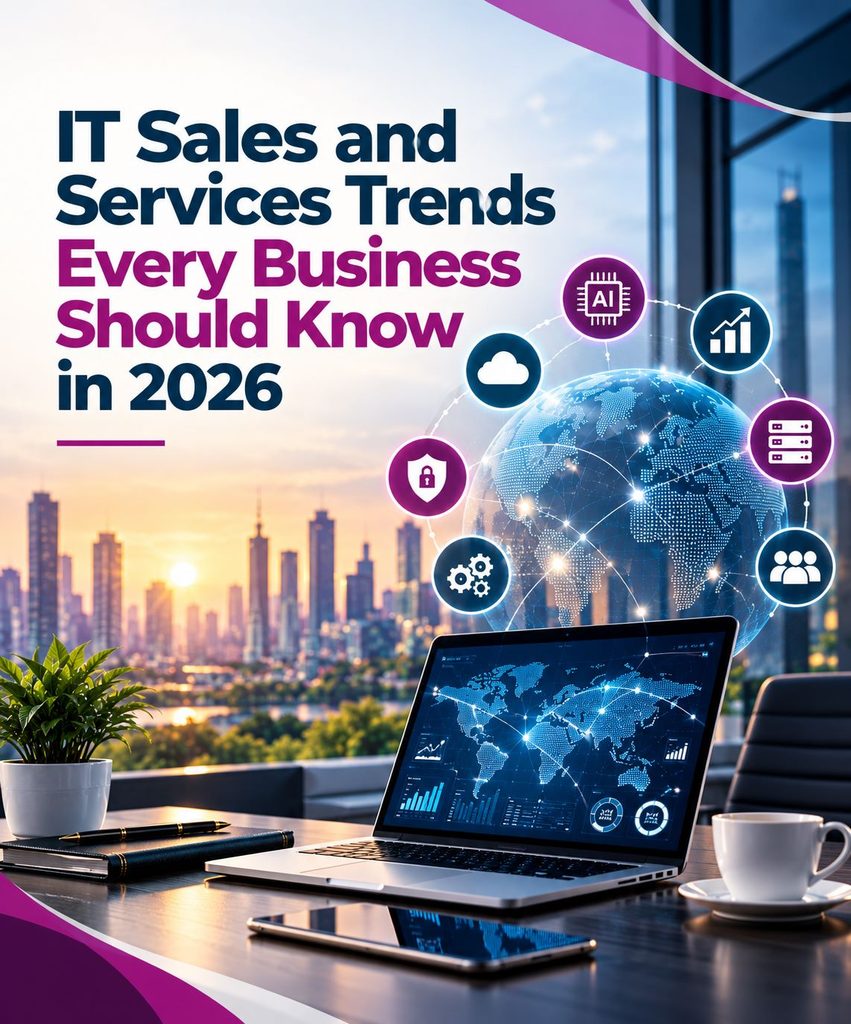
IT Sales and Services Trends Every Business Should Know in 2026
Technology is changing how businesses operate, serve customers, and plan for growth. In 2026, companies are looking beyond purchasing IT equipment and software. They want technology that improves productivity, strengthens security, reduces unnecessary costs, and supports long-term business goals.
For this reason, IT sales and services are becoming increasingly important. From AI-powered solutions to managed IT support, businesses need to understand which technology trends are worth investing in and how they can create real value.
Here are the key IT sales and services trends businesses should know in 2026.
1. AI and Automation Are Changing IT Services
Artificial intelligence is moving beyond experimentation into practical business applications. Companies are exploring AI tools to automate repetitive tasks, analyze information, improve customer support, and streamline daily operations.
IT providers can help businesses evaluate suitable tools, prepare their infrastructure, and integrate new technologies with existing systems. The focus should be on solving specific business problems rather than adopting AI simply because it is popular.
2. Cybersecurity Is a Business Priority
As businesses rely more heavily on digital systems, protecting company data and customer information has become essential. Weak access controls, outdated software, and inadequate backups can expose organizations to serious risks.
In India, Gartner projected that information security spending would reach $3.4 billion in 2026, reflecting the growing importance of cybersecurity.
Businesses should consider security updates, endpoint protection, secure networks, employee awareness, and reliable backup systems when purchasing IT products or choosing service providers.
3. Cloud Solutions Offer Greater Flexibility
Cloud computing allows businesses to access applications, storage, and computing resources without relying entirely on physical infrastructure at their offices.
In 2026, businesses are continuing to assess cloud and hybrid-cloud solutions for collaboration, scalability, and operational flexibility. IT service providers can help with cloud migration, configuration, access management, and ongoing cost reviews.
However, moving everything to the cloud is not always necessary. The right approach depends on business requirements, security considerations, existing systems, and budget.
4. Managed IT Services Are Gaining Importance
Managing IT systems internally can be challenging, especially for businesses with limited technical resources. Managed IT services provide ongoing assistance with areas such as infrastructure, system maintenance, monitoring, and technical support.
The 2026 KPMG Managed Services Outlook highlights the growing role of managed services in AI adoption, cybersecurity, and digital transformation.
For businesses, this model can provide access to specialist expertise and help maintain reliable systems. Before signing an agreement, companies should check the service scope, support hours, response commitments, and pricing.
5. IT Purchasing Is Becoming More Strategic
Businesses are increasingly evaluating technology purchases based on their long-term value rather than the initial price alone.
When buying laptops, servers, networking equipment, or software, companies should consider compatibility, performance, maintenance, licensing, warranty coverage, and future expansion.
A well-planned IT purchase can prevent unnecessary upgrades and reduce avoidable expenses. Working with a knowledgeable IT sales partner can also help businesses compare suitable options before making a commitment.
6. IT Solutions Must Support Business Growth
Technology should adapt as a business grows. More employees, new offices, changing customer expectations, and increasing workloads can create new IT requirements.
Scalable infrastructure, dependable technical support, and well-chosen software can help businesses manage these changes more smoothly.
The key is to review technology needs regularly and invest according to actual business priorities.
How Can Businesses Prepare for IT Trends in 2026?
Businesses do not need to adopt every new technology at once. A practical starting point is to review existing systems, identify recurring problems, and determine where improvements would have the greatest impact.
Before investing, ask three questions:
- What business problem will this technology solve?
- What are the total purchase, implementation, and maintenance costs?
- Can the solution meet future requirements without unnecessary complexity?
These questions help businesses make informed decisions and choose IT sales and services that align with their goals.
How JRK Infotech Can Help
Choosing the right technology starts with understanding your business requirements. Whether your organization is reviewing its IT infrastructure or exploring technology solutions, it is important to assess the available options and confirm the provider’s service capabilities.
Visit JRK Infotech to explore its offerings and learn more about solutions that may fit your business needs.
Frequently Asked Questions
1. What are the major IT sales and services trends in 2026?
Key trends include AI and automation, stronger cybersecurity, cloud adoption, managed IT services, strategic technology purchasing, and scalable infrastructure.
2. Why are IT sales and services important for businesses?
They help businesses select suitable technology products, implement systems, maintain reliable operations, manage IT costs, and access technical expertise.
3. How can small businesses benefit from managed IT services?
Managed IT services can provide access to technical support, system maintenance, and specialist expertise without requiring a large internal IT team.
4. Is cloud computing suitable for every business?
Not necessarily. Cloud computing can improve flexibility, but businesses should evaluate security, cost, performance, compliance, and compatibility before moving workloads.
5. How should businesses choose an IT sales and services provider?
Compare technical expertise, product quality, service scope, pricing transparency, security practices, support commitments, and the provider’s ability to meet future requirements.