
Is C2H better for employers or candidates?
Hiring someone permanently is a big decision for a company. Accepting a new job is an equally important decision for a candidate. Yet both sides often have to make that decision after only a few interviews and limited information about what working together will actually be like.
This is where Contract-to-Hire, commonly known as C2H, offers another option.
Instead of starting with a permanent employment arrangement, a candidate joins on a contract basis for an agreed period. During that time, the employer can assess their work, and the candidate can decide whether the role and workplace meet their expectations. If everything works out, the company may offer permanent employment.
It sounds like a fair arrangement for everyone. But is C2H actually better for employers, or does it offer more advantages to candidates?
The honest answer is that C2H can work well for both sides, but the benefits and risks are different. Let’s look at what each side gains, what each needs to consider, and when this hiring model makes the most sense.
What Is C2H Hiring?
C2H stands for Contract-to-Hire. It is a recruitment model in which a professional initially works under a contract, with the possibility of moving into a permanent position later.
For example, imagine a company needs an experienced software developer for a growing project. The hiring manager likes a candidate’s technical skills but wants to understand how they handle real deadlines, collaborate with the team, and solve problems.
The company brings the developer on board through a C2H Hiring arrangement for an agreed period. The developer works on actual assignments, receives feedback, and learns more about the organisation. At the end of the contract, both sides can decide whether they want to continue with permanent employment.
This arrangement gives the employer more information than an interview alone can provide. It also gives the candidate a realistic view of the job before making a longer-term commitment.
However, a C2H role is not a guaranteed permanent job. Conversion depends on the contract terms, the employer’s requirements, the candidate’s performance, and whether both sides want to proceed.
Is C2H Better for Employers?
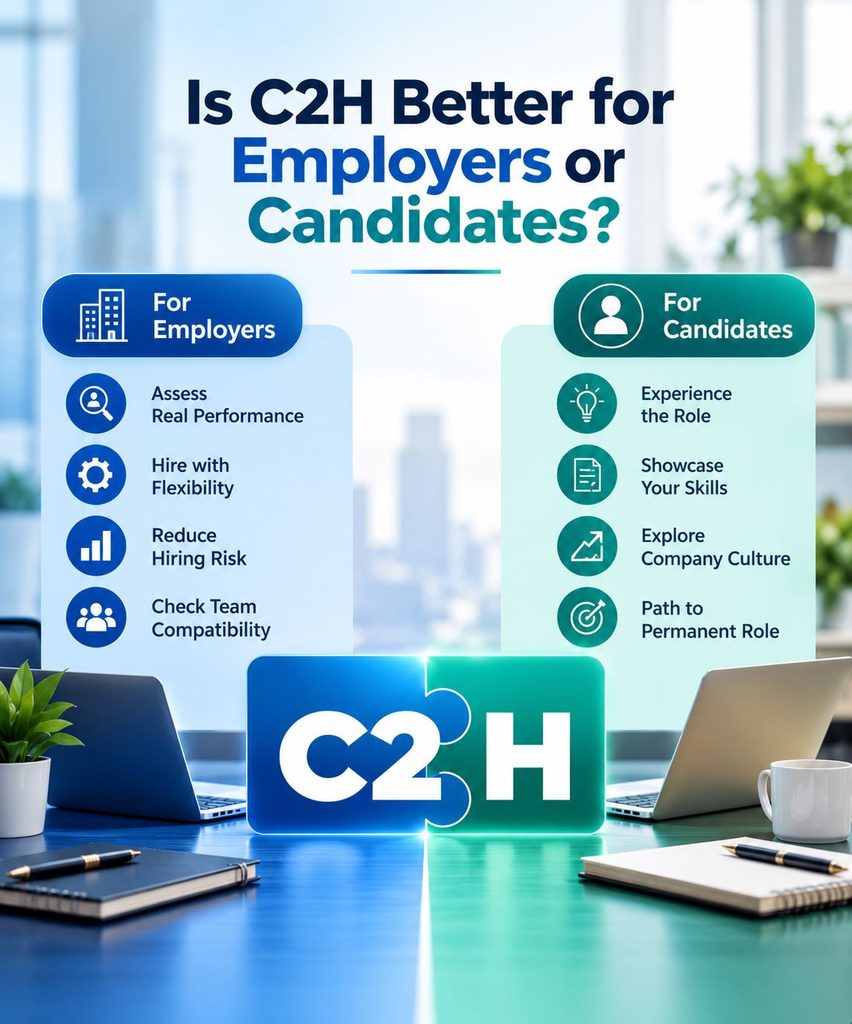
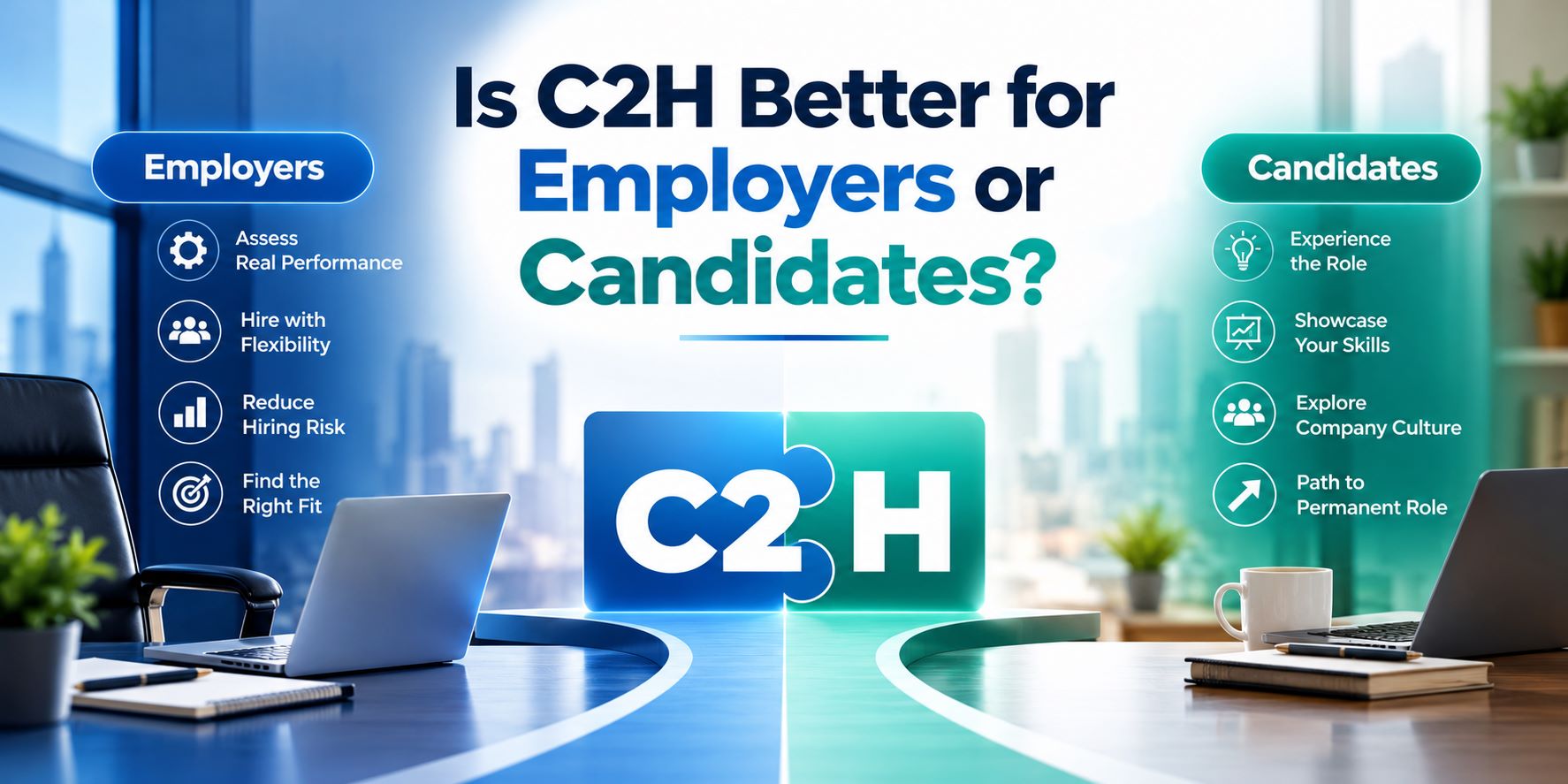
For employers, the main attraction of C2H is the opportunity to assess a candidate through actual work before making a permanent hiring decision.
That can be especially useful when hiring for technical roles, where a candidate’s interview performance may not tell the whole story.
1. Employers can evaluate real performance
An interview can reveal technical knowledge, communication skills, and past experience. It cannot always show how someone will perform when faced with a difficult production issue or a tight project deadline.
With C2H, a company can observe how a developer writes and maintains code, how a cloud engineer handles infrastructure challenges, or how a tester works with the development team.
This additional insight can help managers make a more informed decision about permanent employment.
2. Hiring can be more flexible
Business needs can change quickly. A company might win a new project, expand a development team, or need specialist skills while its permanent hiring approvals are still in progress.
C2H can provide a way to bring in talent while the organisation evaluates its longer-term staffing requirements.
However, it is important to remember that contract hiring is not automatically faster or cheaper. Availability of candidates, onboarding, agency fees, and the terms of the agreement all affect the outcome.
3. Employers can assess team compatibility
Technical ability matters, but so does the ability to work with other people.
During the contract period, managers can see how a candidate communicates, responds to feedback, documents their work, and handles changing priorities.
This is useful when those qualities are difficult to judge during interviews.
The process should still be fair. Employers need to provide clear expectations and regular feedback rather than waiting until the contract ends to explain what went wrong.
4. It can support specialist hiring
Some IT positions require skills that are difficult to evaluate through conventional interviews alone. C2H can be useful for roles involving software development, cloud computing, cybersecurity, data engineering, DevOps, and quality assurance.
The employer gets an opportunity to see how the professional applies their knowledge in the actual working environment.
Where employers need to be careful: C2H should not be treated as a risk-free way to hire. Contracting costs, staffing agreements, compliance obligations, and the possibility that a candidate leaves before conversion still need to be considered.
Is C2H Better for Candidates?
From a candidate’s perspective, C2H offers a different kind of advantage: the opportunity to evaluate the employer while demonstrating their own abilities.
For professionals who want to change jobs, enter a new technical domain, or gain experience with a particular company, that can be valuable.
1. Candidates can experience the workplace before committing
Job descriptions and interviews do not always reflect everyday working conditions.
A role may sound interesting but involve different responsibilities than expected. The management style might not suit the candidate, or the team may use technologies that differ from those discussed during recruitment.
A C2H arrangement can help candidates understand these realities through practical experience.
They can assess the work, team communication, expectations, and opportunities for learning before deciding whether to pursue permanent employment.
2. Practical work can demonstrate skills
Some professionals are better at solving real problems than presenting themselves in interviews.
A C2H role gives them an opportunity to demonstrate their abilities through project contributions, problem-solving, reliability, and collaboration.
For example, a developer who has limited experience with large enterprise interviews might demonstrate their value by delivering a feature, resolving bugs, and working effectively with the existing team.
This does not guarantee permanent conversion, but it provides another way to show what they can do.
3. Candidates can build relevant experience
Contract work can provide exposure to real projects, business processes, and technical environments.
That experience may strengthen a candidate’s professional profile, even if the role does not eventually become permanent.
Candidates should still consider whether the assignment supports their career goals and whether the compensation is appropriate for the responsibilities involved.
4. There may be an opportunity to negotiate after proving value
Once a candidate has demonstrated their contribution, the employer has practical evidence to consider when discussing a permanent offer.
This may help the candidate explain their achievements and negotiate compensation based on their responsibilities and performance.
However, negotiation is not guaranteed to be easier. The final offer depends on the company’s budget, salary structure, market conditions, and the candidate’s alternatives.
Where candidates need to be careful: The biggest concern is uncertainty. A permanent role may never materialise, even if the candidate performs well. Before accepting a C2H offer, candidates should understand the contract duration, salary, benefits, notice period, and conversion conditions.
C2H for Employers vs. Candidates: Which Side Benefits More?
Both sides can benefit, but they benefit in different ways.
| Factor | Employer perspective | Candidate perspective |
|---|---|---|
| Main advantage | Observe performance before deciding on permanent employment | Experience the role before committing long-term |
| Flexibility | Adapt staffing to changing business needs | Explore a new role or workplace |
| Key concern | Recruitment costs, continuity, and the possibility of losing the candidate | Uncertain conversion and job security |
| What matters most | Clear performance goals and a sound hiring agreement | Transparent contract terms and fair compensation |
| Permanent conversion | The employer can decide whether to make an offer under the agreed terms | The candidate can decide whether to accept the offer |
| Best outcome | A capable professional who fits the business’s needs | A suitable role with a clear path to longer-term employment |
The employer may have greater control over the conversion decision, but that does not mean C2H is automatically better for the employer. Candidates also make choices, and skilled professionals may leave if the opportunity does not meet their expectations.
A successful arrangement depends on both sides having a reason to continue.
When Should Employers Choose C2H?
C2H can be a good option when a company needs someone to start working but wants more evidence before making a permanent commitment.
It may suit situations such as:
- Hiring a specialist IT professional whose practical skills are difficult to assess in interviews.
- Expanding a team for a project that may develop into a long-term requirement.
- Evaluating a new role where responsibilities are still taking shape.
- Filling a position while longer-term workforce plans are being finalised.
- Finding professionals who can demonstrate their value through real project work.
On the other hand, if a company has a clearly defined permanent role, an approved budget, and confidence in the candidate, direct permanent hiring may be more attractive.
C2H is also not the best choice when the role is genuinely short-term and there is no intention to consider permanent employment. In that situation, straightforward contract staffing may be more transparent.
When Should Candidates Accept a C2H Job?
A C2H offer may make sense for a candidate who values practical experience, wants to assess a new workplace, or is comfortable with a degree of employment uncertainty.
Before accepting, it is worth asking the recruiter or employer a few direct questions:
- How long is the initial contract?
- Who will employ me and manage my payroll during the contract period?
- What salary, benefits, leave, and statutory contributions are included?
- Is permanent conversion planned, or is it only a possibility?
- What performance criteria will be used to evaluate my work?
- When will the conversion decision be made?
- What notice period applies if I want to leave?
- Will my responsibilities or compensation change if I become a permanent employee?
These questions are not signs of hesitation. They help candidates make a decision based on the actual offer rather than assumptions.
A candidate with another permanent offer should compare the two opportunities carefully. A potentially attractive C2H role may not be worth the uncertainty if job security is the immediate priority.
How Can Companies Make C2H Fair for Both Sides?
C2H works best when neither side feels that important information has been withheld.
Employers should explain the purpose of the contract, what successful performance looks like, and how a permanent offer will be considered. If conversion depends on business approval or budget, that should be communicated clearly.
Managers should also provide regular feedback. A candidate should not have to guess whether their work is meeting expectations.
Candidates, in turn, should communicate their career goals, ask questions about the arrangement, and understand the terms before signing.
Staffing partners also have an important role in explaining the employment structure, coordinating the recruitment process, and ensuring that relevant contract and payroll responsibilities are clear.
In India, the exact responsibilities of the staffing provider and client company depend on the arrangement and applicable requirements. The written agreement should clarify who is responsible for employment documentation, payroll, statutory obligations, and the permanent conversion process.
The aim should be a genuine opportunity for both sides to evaluate the relationship, not a permanent role that is promised but never seriously considered.
How JRK Infotech Can Help With C2H Hiring
Finding the right IT professional is about more than filling an open position. Employers need people who can contribute to projects, work effectively with their teams, and support business goals.
JRK Infotech provides IT staffing and recruitment solutions to help businesses find professionals suited to their requirements. For companies considering C2H, a structured recruitment process can help clarify the role, identify relevant candidates, and set expectations before the engagement begins.
Whether you are building a development team or looking for professionals with specialised technical skills, choosing the right hiring model is an important first step.
Explore JRK Infotech to learn more about its staffing and recruitment services.
Frequently Asked Questions (FAQs)
1. Is C2H better for employers or candidates?
C2H offers advantages to both. Employers can assess practical performance before considering permanent employment, while candidates can experience the role and workplace before committing. Which side benefits more depends on the contract terms and individual priorities.
2. Is a C2H job better than a permanent job?
Not necessarily. A permanent job usually offers greater certainty about ongoing employment, while C2H provides an opportunity to evaluate the working relationship. Candidates who prioritise stability may prefer direct employment, whereas those comfortable with some uncertainty may value C2H.
3. Do C2H jobs guarantee permanent employment?
No. Contract-to-hire means permanent employment may be offered later; it does not automatically guarantee conversion. Candidates should ask how conversion decisions are made and review the written terms carefully.
4. What are the main disadvantages of C2H for employers?
Employers may face additional staffing costs, administrative requirements, and the risk that a candidate leaves before conversion. They may also lose time if the evaluation process is poorly planned or the role’s requirements are unclear.
5. What are the risks of C2H for candidates?
The main risks include uncertain permanent conversion, differences between the contract and a future permanent offer, and possible differences in pay or benefits. Candidates should review compensation, employment arrangements, notice periods, and conversion expectations before joining.
6. How long does a C2H contract usually last?
The duration depends on the role and the agreement. Some arrangements last three months, while others may run for six or twelve months. The contract should specify the agreed period and any conditions for extension or conversion.
7. Can a candidate leave a C2H job before the contract ends?
This depends on the employment agreement and applicable rules. Candidates should check the notice period and any other exit conditions before accepting the role.
8. Is C2H suitable for IT professionals?
Yes. C2H can be useful for software developers, cloud engineers, cybersecurity specialists, testers, data professionals, and other IT roles where practical skills and team collaboration are important.
9. What should employers consider before using C2H?
Employers should assess whether the role may become permanent, define the evaluation criteria, understand the full cost of the arrangement, and agree on the contract and conversion terms with their staffing partner.
10. How can a candidate improve their chances of permanent conversion?
Candidates can improve their prospects by understanding expectations early, delivering reliable work, communicating openly, responding to feedback, and demonstrating how their contributions support the team. Even strong performance cannot guarantee conversion if the business no longer needs the role or cannot approve the position.