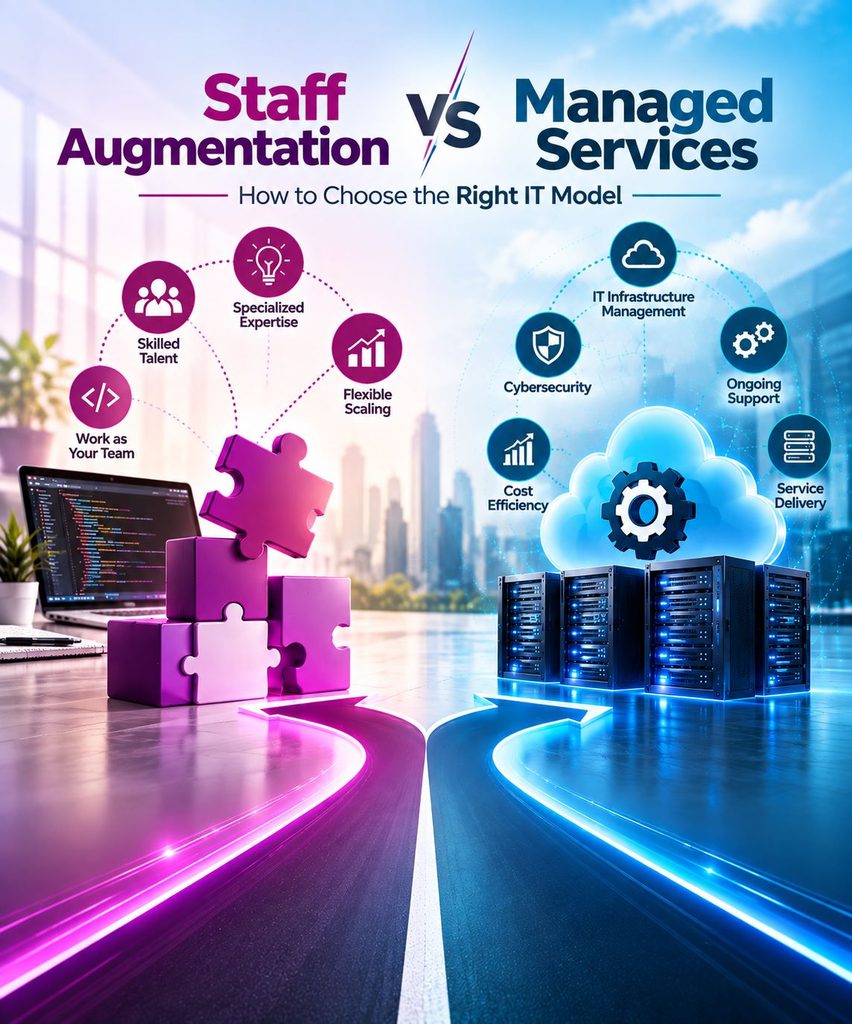

Staff Augmentation or Managed Services? How to Choose the Right IT Model
Imagine your IT team is working on an important project, but there is one problem: you do not have enough people with the right skills.
You could hire a few experienced developers, cloud engineers, or support specialists to work alongside your existing team. Or, you could hand over an entire IT function to an external provider and let them manage the work for you.
Both approaches can solve the talent and technology gap, but they are not the same. This is where the difference between staff augmentation and managed services becomes important.
Choosing the right model depends less on what is popular and more on what your business actually needs.
What Is Staff Augmentation?
With IT staff augmentation, you add external professionals to your existing team.
For example, suppose your company is developing a new application and your internal team is short of two experienced developers. Instead of spending months recruiting permanent employees, you could bring in skilled professionals through a staffing partner.
They work as part of your team, while your managers continue to decide what needs to be done, how the project is managed, and which priorities come first.
This makes staff augmentation particularly useful when you already have an internal team but need additional expertise or capacity.
What Are Managed Services?
Managed services take a different approach.
Instead of adding individuals to your team, you outsource responsibility for a defined IT function to an external provider. The provider manages the service and works toward agreed objectives and service levels.
This could include areas such as:
- IT helpdesk and technical support
- Cloud management
- Network monitoring
- Cybersecurity
- Infrastructure management
- Application support
For example, a company that does not want to manage its IT infrastructure internally could work with a managed services provider that takes responsibility for maintaining and supporting it.
Staff Augmentation vs Managed Services: What Is the Difference?
The easiest way to understand the difference is to look at who manages the work.
With staff augmentation, your company manages the professionals. You decide their priorities, assign tasks, and oversee the project.
With managed services, the service provider takes greater responsibility for delivering the agreed service.
That distinction can make a big difference.
If you have a strong internal IT team and simply need more hands or specialized skills, staff augmentation may fit naturally into your existing structure.
If your internal team does not want to manage a particular IT function, managed services may make more sense.
When Does Staff Augmentation Make Sense?
Staff augmentation can be a practical option when your requirements are likely to change.
Perhaps you are launching a new application and need additional developers for several months. Maybe you need a cybersecurity specialist for a particular initiative. Or perhaps your team needs experienced cloud professionals during a migration.
In these situations, adding skilled people without changing the way your internal team operates can give you more flexibility.
It can also be useful when you want to retain direct control over the project while gaining access to skills that are difficult to find internally.
When Should You Consider Managed Services?
Managed services can be useful when you want someone else to take responsibility for an entire IT function.
For instance, a growing company may not want to build and manage its own 24/7 IT support operation. Rather than hiring, training, scheduling, and managing a large internal team, it could outsource that function to a specialist provider.
The same thinking can apply to infrastructure, cloud operations, cybersecurity, or application support.
The focus shifts from adding people to outsourcing responsibility for an outcome or service.
Which Model Is Right for Your Business?
There is no universal answer.
Start by asking a simple question:
Do we need more people, or do we need someone to take responsibility for a service?
If you need additional talent while keeping project management inside your organization, staff augmentation may be the more suitable model.
If you want an external partner to manage a defined IT function, managed services may be worth considering.
Your decision should also take into account the project’s duration, internal expertise, budget, level of control, security requirements, and how quickly your needs may change.
How JRK Infotech Can Help
The right IT model starts with understanding the problem you are trying to solve.
Whether you need skilled professionals to strengthen your existing team or support for specific technology functions, JRK Infotech can help businesses explore flexible IT staffing and technology solutions based on their requirements.
The goal is not simply to add more people or outsource more work. It is to find an approach that fits the way your business actually operates.
Frequently Asked Questions
What is staff augmentation in IT?
IT staff augmentation is a hiring model where external IT professionals join an existing team to provide additional skills or capacity while the company retains control over the project and day-to-day work.
What are managed IT services?
Managed IT services involve outsourcing a defined IT function to an external provider that takes responsibility for managing and delivering that service.
Is staff augmentation cheaper than managed services?
There is no universal answer. Costs depend on the skills required, project duration, service scope, team size, and contractual terms. Businesses should compare the total cost against the level of control and responsibility they need.
Which is better for a short-term IT project?
Staff augmentation can be useful when you need additional professionals for a specific project while keeping management in-house. The right choice still depends on the project’s requirements.
Can a company use staff augmentation and managed services together?
Yes. A business can use staff augmentation for areas where it needs additional talent and managed services for IT functions it prefers to outsource.
How do I choose between staff augmentation and managed services?
Look at whether you need additional people or want to outsource responsibility for a complete IT function. Then consider your internal capabilities, project requirements, budget, desired level of control, and long-term plans.