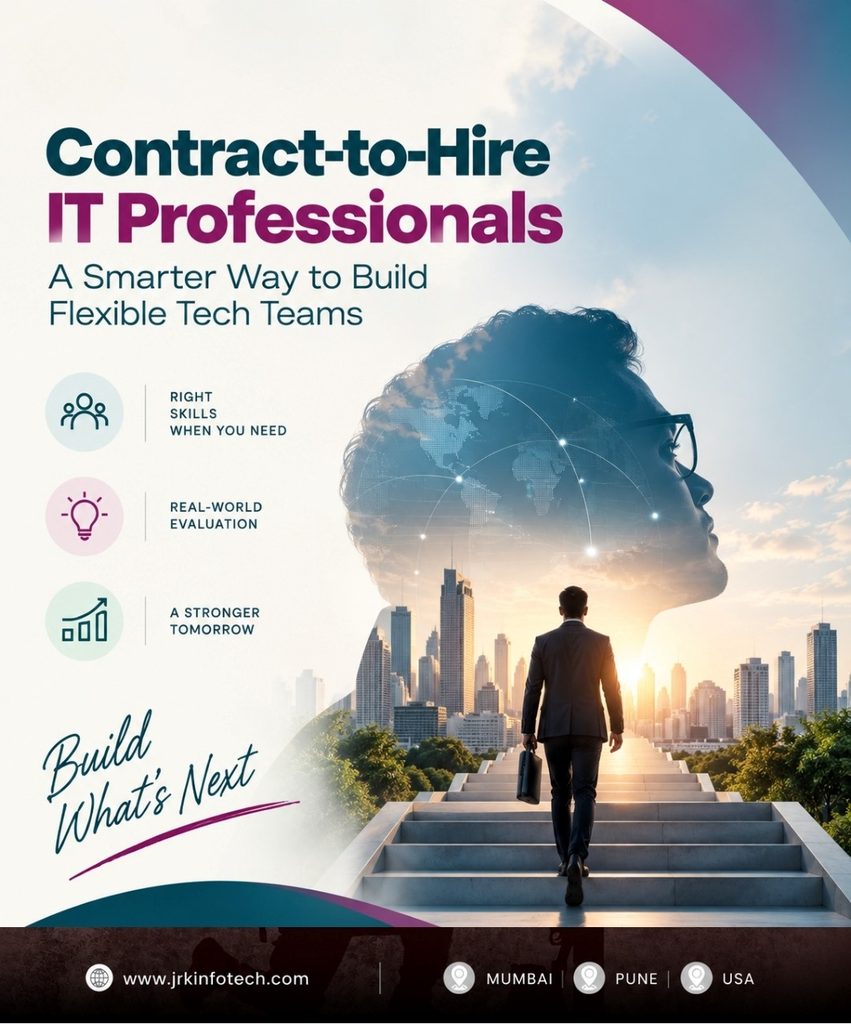


Contract-to-Hire IT Professionals: A Smarter Way to Build Flexible Tech Teams
Finding the right IT professional is not always as simple as matching a resume with a job description.
A candidate may have the right technical skills and impressive experience, but there is another question that matters just as much: Will this person actually work well with our team and our projects?
That is one of the reasons more businesses are exploring contract-to-hire IT professionals.
Instead of making a permanent hiring decision from day one, companies can bring a professional into the team on a contract basis, work together for an agreed period, and understand how the relationship develops. If everything works well, there may be an opportunity to move into a permanent position.
For companies dealing with changing technology requirements, tight project timelines, or specialized skill requirements, this approach can offer useful flexibility.
What Are Contract-to-Hire IT Professionals?
Contract-to-hire IT professionals are technology specialists who initially join an organization through a contractual arrangement, with the possibility of becoming permanent employees later.
The idea is fairly straightforward.
A company has an IT requirement. Instead of immediately making a permanent appointment, it brings in a suitable professional for a defined period. During that time, both sides get to experience the working relationship.
The company can see how the professional handles real projects, deadlines, collaboration, communication, and technical challenges.
The professional, meanwhile, gets a chance to understand the company’s culture, team, technology environment, and expectations.
If both sides see a long-term fit, permanent employment can be considered based on the company’s requirements and the terms agreed upon.
Why Is Contract-to-Hire Becoming an Attractive Option?
IT hiring has changed significantly. Companies are adopting new technologies, launching digital projects, expanding applications, moving workloads to the cloud, and dealing with increasingly specialized technology requirements.
That means hiring needs can change quickly.
A company might need a developer for an important product release today and a cloud specialist for a migration project a few months later. In some cases, the business knows it needs additional talent but is not yet certain what the long-term team structure will look like.
This is where contract-to-hire can be useful.
It gives organizations another option between traditional permanent hiring and short-term contracting.
You Get to See More Than a Resume
One of the biggest advantages of working with contract-to-hire IT professionals is the opportunity to see how someone performs in an actual work environment.
Interviews are important. Technical assessments are important too. But neither can completely recreate the experience of working on a real project with a real team.
Once a professional joins the project, the company can observe things that are difficult to measure during an interview.
How do they approach an unexpected problem?
How do they communicate when a deadline is approaching?
Do they ask the right questions?
Can they work independently while still collaborating with the team?
These practical experiences can provide useful information when the company is considering a long-term hiring decision.
Flexibility Without Giving Up Access to Talent
Technology projects rarely remain exactly as they were planned six months earlier.
Requirements change. Priorities shift. New tools are introduced. Teams grow or reorganize.
For this reason, companies often need a more flexible approach to workforce planning.
Contract-to-hire allows businesses to bring in skilled professionals while keeping some flexibility around their longer-term staffing plans.
This can be particularly useful for companies that are:
- Starting a new technology project
- Expanding an existing development team
- Looking for specialized technical skills
- Supporting a temporary increase in workload
- Exploring a new technology area
- Scaling teams during digital transformation initiatives
It does not mean every role should be filled through contract-to-hire. Rather, it gives companies another option when a traditional permanent hire may not be the best starting point.
What Types of IT Professionals Can Be Hired This Way?
Contract-to-hire is not limited to one particular area of technology.
Depending on business requirements, companies may use this approach to find professionals in areas such as:
- Software development
- Full-stack development
- Front-end and back-end development
- Cloud computing
- DevOps
- Data engineering
- Data analytics
- Cybersecurity
- Quality assurance
- Technical support
- Application support
- System administration
- Business analysis
- IT project management
The right role depends on the organization’s project and workforce requirements.
For example, a company preparing for a cloud migration may need experienced cloud and DevOps professionals. Another organization developing a new application may need software developers and QA specialists.
The hiring model can be adapted to both situations.
How Does the Contract-to-Hire Process Work?
There is no single process that every organization follows, but most contract-to-hire engagements begin with a clear understanding of the company’s requirement.
The business first identifies what it needs: the technology, experience level, responsibilities, project scope, and expected outcomes.
The recruitment partner then searches for professionals who match those requirements.
After screening and interviews, a suitable candidate joins the organization under agreed contractual terms.
The important part comes next.
Instead of simply waiting until the contract ends, the company and professional should maintain regular communication throughout the engagement. Performance, responsibilities, project progress, and expectations should be discussed openly.
If the working relationship develops well and there is a suitable permanent requirement, the company and professional can discuss the possibility of a long-term position.
Contract-to-Hire Is Also About the Candidate
It is easy to look at contract-to-hire only from the employer’s perspective. But the arrangement can be valuable for IT professionals as well.
Imagine accepting a permanent position and discovering after a few months that the technology environment, management style, or project is completely different from what you expected.
A contract-to-hire arrangement can provide an opportunity to understand the organization before making that long-term decision.
Professionals can experience the company’s working environment, meet the team, contribute to real projects, and understand what the role actually involves.
At the same time, they get an opportunity to demonstrate their skills through their work rather than relying entirely on their interview performance.
If both sides are happy with the relationship, the role may eventually become permanent.
Contract-to-Hire vs Permanent Hiring
The two approaches are designed for different situations.
With permanent hiring, the candidate joins the organization directly as a permanent employee. The company makes its long-term hiring decision before the employee starts.
With contract-to-hire, there is an initial contractual period before a potential permanent transition.
For example, a business that has a clearly established long-term requirement for a senior software engineer may choose direct permanent hiring.
On the other hand, a company launching a new project and wanting to understand the role, team structure, and candidate fit before making a permanent commitment may consider contract-to-hire.
The right choice depends on the company’s circumstances.
What Makes a Contract-to-Hire Arrangement Successful?
Simply hiring someone on contract does not guarantee that the arrangement will work.
The foundation is clarity.
Both the company and professional should understand what is expected before the engagement begins.
That includes the role, responsibilities, compensation, contract duration, working arrangements, performance expectations, and the conditions surrounding any potential permanent transition.
It is also important not to treat permanent employment as guaranteed unless it has been formally agreed.
Regular feedback helps too.
If a professional is struggling with a particular process or the company feels expectations are not being met, discussing the issue early gives both sides an opportunity to address it.
A good contract-to-hire experience should feel like a genuine working relationship, not an extended interview.
The Role of an IT Recruitment Partner
Finding skilled technology professionals can take considerable time, particularly when the role requires specific technical expertise.
This is where an experienced IT recruitment partner can add value.
A recruitment partner can help understand the requirement, identify relevant candidates, manage initial screening, coordinate interviews, and support the onboarding process.
For businesses that regularly need technology talent, having access to a reliable talent pipeline can also make future hiring easier.
At JRK Infotech, the focus is on helping businesses find IT professionals based on their specific technology and workforce requirements. A structured approach to IT recruitment can help organizations build teams that are not only technically capable but also aligned with their project needs.
When Should a Business Consider Contract-to-Hire?
There is no universal answer, but the model may make sense when a company needs flexibility around its hiring decision.
For example, consider a company that has won a major technology project and needs experienced developers quickly. It knows it needs additional talent but wants to understand how the project develops before deciding the final size of the permanent team.
Contract-to-hire could provide one possible solution.
The same may apply to a company entering a new technology area. Rather than immediately building a permanent team, it could bring in experienced professionals, understand the requirements, and make longer-term decisions based on what it learns.
Challenges to Keep in Mind
Like any hiring model, contract-to-hire comes with considerations.
The first is communication. Candidates should understand from the beginning that permanent employment is a possibility, not necessarily a guarantee.
The second is expectations. Companies should define responsibilities and performance requirements clearly.
There is also the question of continuity. If a professional does not transition to a permanent role, the company may need to consider how the work will be handed over.
These challenges can be managed with proper planning and transparent communication.
Building More Adaptable Technology Teams
The way businesses build IT teams is changing.
Companies today may need to scale quickly, access niche skills, respond to new technology requirements, or support projects that have uncertain long-term needs.
That does not mean traditional permanent hiring is becoming less important. Permanent employees remain an essential part of many successful technology teams.
But businesses now have more options.
Contract-to-hire IT professionals can provide a middle ground for organizations that want access to skilled talent while having time to evaluate the relationship before making a longer-term decision.
When expectations are clear and the process is managed properly, it can benefit both the business and the professional.
Frequently Asked Questions
What are contract-to-hire IT professionals?
Contract-to-hire IT professionals are technology specialists who initially work with a company under a contractual arrangement, with the possibility of moving into a permanent role later.
Is contract-to-hire the same as temporary IT staffing?
Not necessarily. Temporary staffing generally refers to a defined short-term assignment. Contract-to-hire specifically includes the possibility of transitioning to permanent employment if both parties agree.
Does every contract-to-hire role become permanent?
No. Permanent conversion depends on the professional’s performance, business requirements, availability of a suitable position, and mutual agreement between the relevant parties.
How long does a contract-to-hire arrangement last?
There is no standard duration. The length depends on the role, project, company, and contractual terms.
What are the advantages of hiring IT professionals on a contract-to-hire basis?
It can give businesses access to specialized talent, greater workforce flexibility, and an opportunity to evaluate a professional’s capabilities in a real working environment before considering permanent employment.
Is contract-to-hire useful for software development teams?
Yes. Software development projects often have changing requirements, deadlines, and technology needs, making contract-to-hire one possible approach for accessing additional development talent.
Can contract-to-hire professionals work remotely?
That depends on the company’s requirements and the terms of the engagement. Some roles may be remote, while others may require hybrid or onsite work.
What should companies discuss before starting a contract-to-hire engagement?
Companies and candidates should discuss responsibilities, compensation, contract duration, working arrangements, performance expectations, and the terms surrounding any potential permanent employment.
How can a company find reliable contract-to-hire IT professionals?
Businesses can work with an experienced IT recruitment or staffing provider that understands their technology requirements and can help identify and screen relevant professionals.