Best IT Staffing Solutions for Businesses in 2026
The technological landscape is ever-evolving, and as businesses look towards 2026, the demand for specialized IT talent continues to outpace supply. Navigating this complex environment requires strategic foresight and a clear understanding of the best staffing solutions available. This article explores the top IT staffing solutions designed to help businesses thrive in the competitive market of 2026.
The Evolving Landscape of IT Staffing in 2026
By 2026, several key trends will significantly impact IT staffing:
- Accelerated Digital Transformation: Businesses will continue to heavily invest in digital initiatives, requiring expertise in areas like cloud migration, data analytics, and automation.
- Dominance of Niche Technologies: Skills in Artificial Intelligence (AI), Machine Learning (ML), advanced cybersecurity, quantum computing, Web3, and specialized cloud platforms will be in extremely high demand.
- Persistent Skill Gaps: The gap between available talent and required specialized skills will likely widen, particularly for emerging technologies.
- Hybrid and Remote Work Models: Flexible work arrangements will remain a cornerstone of talent attraction and retention, necessitating solutions that can source talent globally.
- Emphasis on Data-Driven Decision Making: IT teams will increasingly need professionals who can not only manage systems but also derive actionable insights from data.
Key Challenges in IT Staffing for 2026
Businesses face several hurdles in securing the right IT talent:
- Attracting Top-Tier Talent: Highly skilled IT professionals are often courted by multiple companies, making differentiation and competitive offers crucial.
- Retaining Expertise: The cost of turnover in IT is substantial, emphasizing the need for robust retention strategies.
- Budget Constraints vs. Quality: Balancing the need for top talent with financial realities without compromising project quality.
- Rapid Technological Obsolescence: Skills can become outdated quickly, requiring continuous upskilling and a proactive approach to talent development.
- Cultural Fit in Distributed Teams: Ensuring new hires seamlessly integrate into company culture, especially within hybrid or fully remote setups.
Top IT Staffing Solutions for Businesses in 2026
To overcome these challenges, businesses need to adopt flexible and effective IT staffing strategies.
1. Specialized IT Staffing Agencies
Description: These agencies focus exclusively on recruiting IT professionals across various domains, from software development and network engineering to cybersecurity and cloud architecture.
- Pros for 2026:
- Access to a pre-vetted pool of candidates, including passive job seekers.
- Expertise in niche tech markets and understanding of specific skill requirements.
- Faster time-to-hire due to established networks and efficient screening processes.
- Offer temporary, contract-to-hire, and permanent placement options.
- When to Use: Ideal for critical, hard-to-fill roles, project-based needs, or when internal recruitment resources are stretched.
2. Managed Service Providers (MSPs)
Description: MSPs take responsibility for managing specific IT functions or infrastructure components, such as cybersecurity operations, cloud management, network monitoring, or help desk support.
- Pros for 2026:
- Access to a team of experts without the overhead of hiring full-time staff.
- Scalability: Easily ramp services up or down based on business needs.
- Cost-effective for specific functions, often predictable monthly costs.
- Focus on proactive maintenance and specialized expertise (e.g., advanced threat detection).
- When to Use: Best for outsourcing critical but non-core IT functions, ensuring specialized expertise, or achieving operational efficiency.
3. IT Consulting Firms
Description: These firms provide strategic guidance, project management, and implementation support for complex IT initiatives. They often bring in teams of experts for defined projects.
- Pros for 2026:
- Access to high-level strategic expertise and best practices.
- Ideal for specific projects (e.g., system integrations, digital transformations, AI strategy).
- Temporary access to specialized skills without long-term commitment.
- Objective external perspective on IT challenges.
- When to Use: For large-scale projects, strategic planning, overcoming specific technical challenges, or when a business lacks internal expertise in a new domain.
4. Freelance Platforms and the Gig Economy (Specialized IT)
Description: Platforms like Upwork, Toptal, and specialized niche platforms connect businesses with independent IT contractors for project-based work.
- Pros for 2026:
- High flexibility and quick access to a global talent pool.
- Cost-effective for short-term projects or specific tasks.
- Access to highly specialized niche skills (e.g., a specific blockchain developer, a rare AI algorithm expert).
- Reduced overhead (no benefits, taxes, etc., associated with full-time employees).
- When to Use: For short-term projects, proof-of-concept development, filling temporary skill gaps, or accessing highly specialized, intermittent expertise.
5. Recruitment Process Outsourcing (RPO)
Description: RPO involves outsourcing all or part of a company’s recruitment functions to an external provider. This can include sourcing, screening, interviewing, and onboarding.
- Pros for 2026:
- Streamlined and optimized recruitment processes.
- Access to recruitment expertise and technology.
- Scalability for high-volume hiring needs or rapid growth.
- Potential for cost savings compared to building an internal recruitment team.
- Improved candidate experience and employer brand.
- When to Use: For companies experiencing rapid growth, high-volume IT hiring, or those looking to professionalize and optimize their recruitment strategy.
6. In-house Talent Development and Upskilling
Description: Investing in training, certifications, and internal mobility programs to develop existing employees’ IT skills and prepare them for future roles.
- Pros for 2026:
- Builds a loyal, engaged workforce familiar with company culture.
- Sustainable long-term strategy for addressing skill gaps.
- Reduces external recruitment costs and time-to-hire for new roles.
- Enhances employee retention and satisfaction.
- When to Use: As a foundational, continuous strategy. Essential for future-proofing your workforce and building internal resilience against skill shortages.
Factors to Consider When Choosing an IT Staffing Solution
Selecting the right solution requires careful consideration of several factors:
- Specific Skill Requirements: Is it a common skill or a highly niche technology?
- Project Duration and Scope: Is it a long-term strategic role, a defined project, or a temporary task?
- Budget: What are the financial constraints for hiring and ongoing costs?
- Time-to-Hire: How quickly is the talent needed?
- Company Culture: How important is cultural fit, and can the solution accommodate it?
- Scalability Needs: Will the need for talent fluctuate significantly?
- Geographic Reach: Is remote/global talent an option, or is local presence required?
Frequently Asked Questions (FAQs)
1. What are IT staffing solutions?
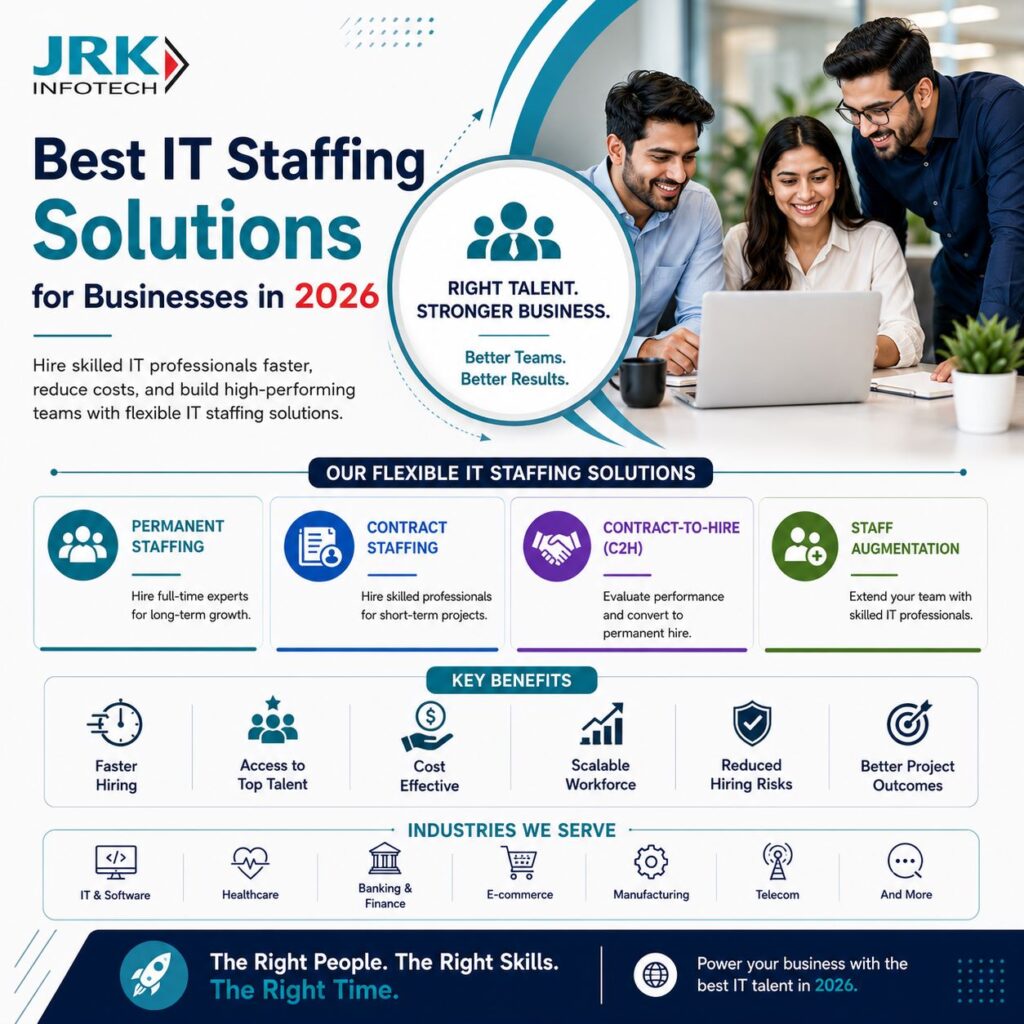
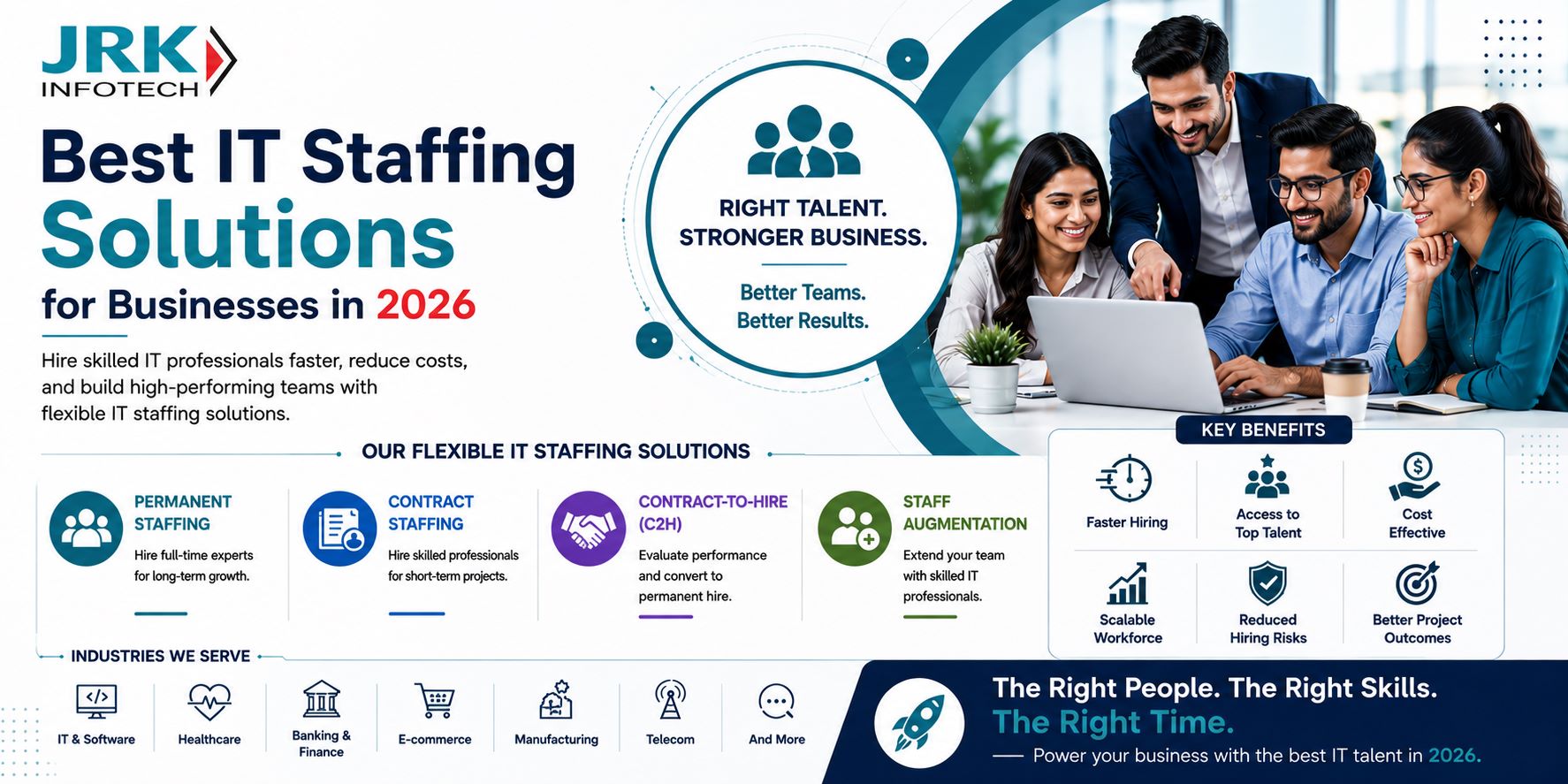
IT staffing solutions are recruitment services that help businesses hire skilled IT professionals for permanent, contract, C2H, or staff augmentation roles.
2. What are the benefits of IT staffing services?
They offer faster hiring, access to specialized talent, lower recruitment costs, flexible hiring models, and improved workforce scalability.
3. Which industries use IT staffing solutions?
Industries such as IT, banking, healthcare, manufacturing, retail, logistics, e-commerce, education, and telecommunications commonly use IT staffing services.
4. What is the difference between contract staffing and permanent staffing?
Contract staffing is for temporary or project-based work, while permanent staffing focuses on hiring full-time employees for long-term roles.
5. What is staff augmentation?
Staff augmentation is a hiring model where businesses temporarily add skilled IT professionals to their existing teams to meet project demands.
6. Why is C2H hiring popular?
Contract-to-Hire allows employers to evaluate candidates before offering permanent employment, reducing hiring risks and improving retention.
7. How do IT staffing companies find qualified candidates?
They use talent databases, professional networks, technical assessments, interviews, and background verification to identify suitable candidates.
8. How can businesses choose the right IT staffing partner?
Look for industry experience, technical expertise, a strong recruitment process, flexible hiring models, quality support, and a proven track record.