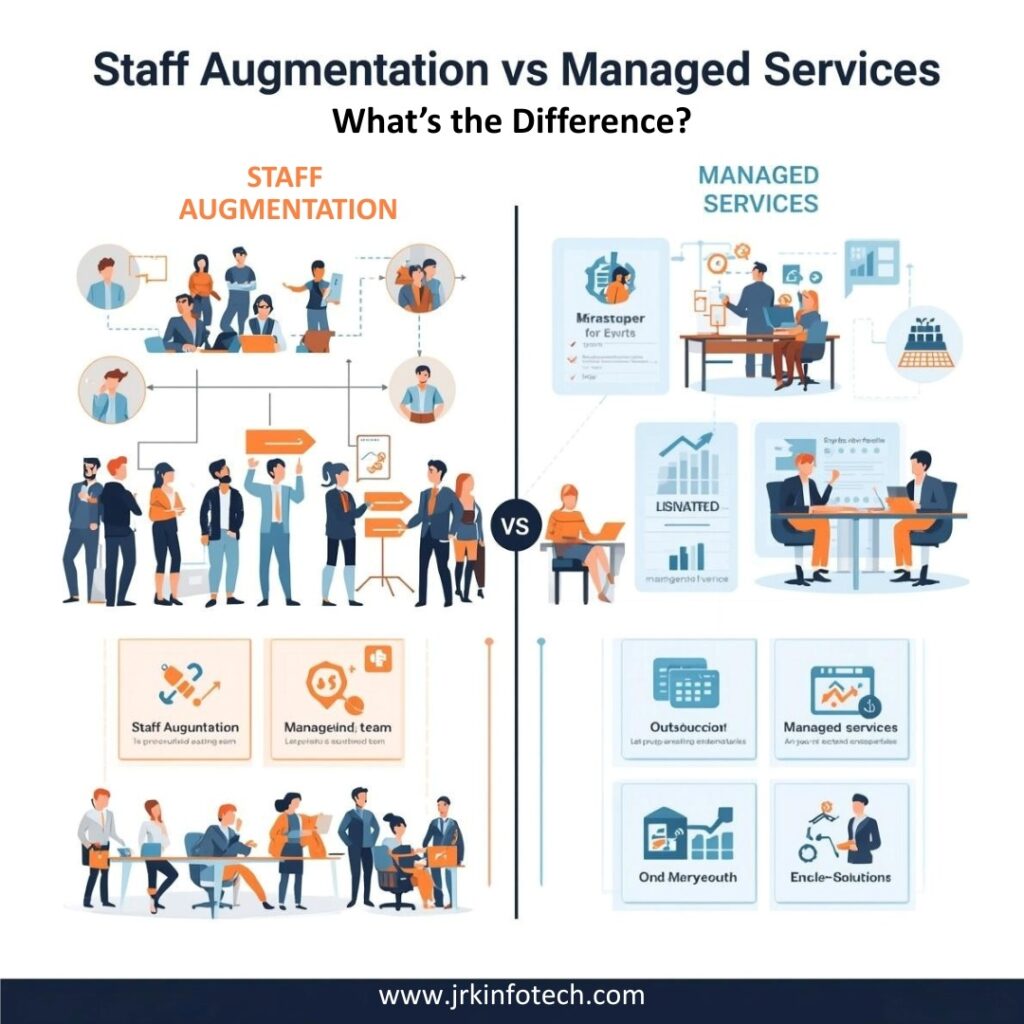

Staff Augmentation vs Managed Services: What’s the Difference?
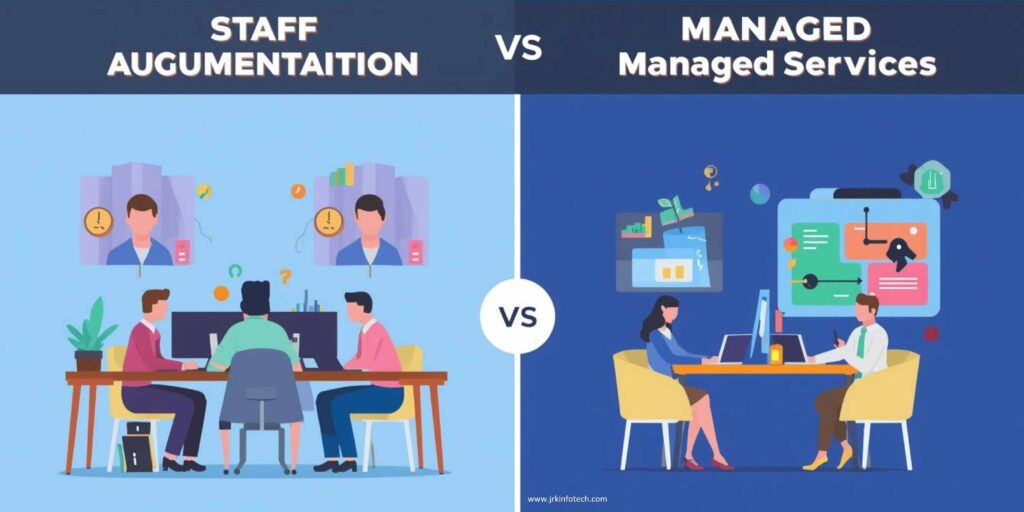
Staff augmentation and managed services are two of the most common outsourcing models used by businesses today, especially in software development, IT operations, and digital transformation. While both help companies access external expertise, they work in very different ways and suit distinct business needs. Understanding the difference between staff augmentation and managed services enables you to choose the right model for your projects, budget, and long‑term strategy.
What is staff augmentation?
Staff augmentation is a flexible outsourcing model where you integrate external professionals into your existing internal team for a specific project or time period. Instead of hiring full‑time employees, you “augment” your workforce with contract developers, QA engineers, designers, DevOps specialists, or business analysts who work under your guidance and follow your processes.
In this model, your company retains full control over project planning, scope, timelines, and day‑to‑day management. The outsourcing partner’s role is to provide the right talent and ensure that the resources understand your tech stack, workflows, and business goals. Staff augmentation is particularly useful when you have a strong internal leadership team but need to quickly fill skill gaps, scale up for a product launch, or handle short‑term spikes in workload.
Because you pay mainly for the people and hours used, staff augmentation is often cost‑effective for project‑based work. It also allows you to scale the team up or down as requirements change, without long‑term commitments or complex contracts.
What are managed services?
Managed services is an outsourcing model where you hand over an entire business process or technical function to a third‑party provider to operate and manage on your behalf. Instead of hiring individual resources, you contract a team or company that owns the end‑to‑end delivery of a service, such as IT operations, cloud infrastructure, cybersecurity, helpdesk support, or application maintenance.
In this setup, the provider is responsible for service performance, availability, incident response, monitoring, and adherence to agreed SLAs (Service Level Agreements). You typically pay a fixed or subscription‑based monthly fee and interact with the provider more like a customer than a line manager. The focus is on outcomes-uptime, response time, and service reliability-rather than the details of who is doing the work and how many hours they spend.
Managed services are ideal when you want to offload operational complexity, reduce internal overhead, and benefit from a provider’s specialized expertise and economies of scale. This model is commonly used for long‑term, ongoing functions that require continuous support, rather than one‑off projects.
Core differences between staff augmentation and managed services
The biggest difference between the two models lies in control versus responsibility.
- In staff augmentation, your internal team remains in control of the project. You define the requirements, set priorities, manage tasks, and oversee delivery. The external professionals simply integrate into your workflow and act like extended team members.
- In managed services, the provider takes ownership of outcomes. You define service expectations and SLAs, but the provider handles how the work is organized, which tools to use, and how to resolve issues.
Another key distinction is scope of work. Staff augmentation focuses on people and specific roles: you bring in developers, testers, or analysts for a defined purpose. Managed services focuses on functions or processes: you outsource IT operations, infrastructure management, or customer support as a complete package.
Cost structure also differs. Staff augmentation is usually billed per resource or per hour, making it flexible for changing workloads. Managed services typically use fixed or recurring pricing, which can be more predictable for budgeting but comes with less short‑term flexibility.
Duration and flexibility vary too. Staff augmentation is often project‑based or short‑term, making it easy to ramp up or down as business needs change. Managed services are usually tied to longer‑term contracts, since they are designed for continuous, stable operations.
Finally, the skill versus operations focus is different. Staff augmentation helps you temporarily fill skill gaps or add specialized expertise. Managed services provide ongoing operational support and maintenance, reducing the burden on your internal teams.
When to choose staff augmentation
Staff augmentation is a strong fit when:
- You already have a capable internal team and just need extra hands or niche skills for a time‑bound project, such as a product launch, migration, or feature development.
- You want to maintain control over design decisions, architecture, and project management, and only outsource the execution.
- You prefer flexible resourcing and pay‑as‑you‑go billing instead of long‑term financial commitments.
- Your workload is seasonal or project‑based, and you need to scale your team quickly without going through a full hiring cycle.
This model is especially popular in software development, where teams augment their core developers with specialists in areas like cloud, AI, or testing. It also helps startups and mid‑sized companies bridge skill gaps without over‑hiring internally.
When to choose managed services
Managed services make more sense when:
- You want to outsource an entire function-such as IT infrastructure, cloud management, cybersecurity, or customer support-to reduce internal overhead and complexity.
- You need predictable monthly costs and clear SLAs instead of tracking individual hours or contractors.
- You require 24/7 monitoring, incident response, and continuous maintenance, and do not want your internal staff to handle operational firefighting.
- You want to leverage the provider’s scale, tools, and best practices without building and maintaining everything in‑house.
Many enterprises use managed services for foundational functions like email systems, network operations, or helpdesk, while keeping product development and innovation closer to their core teams.
Using both models together
The most effective approach for many organizations is to combine staff augmentation and managed services. You can use staff augmentation for short‑term projects, new features, or specialized roles, while relying on managed services for long‑term, stable operations. For example, a company might augment its product team with external developers for a six‑month product overhaul, while outsourcing its cloud infrastructure and security to a managed services provider.
This hybrid setup lets you stay agile on projects, control key product decisions, and still benefit from the efficiency and reliability of managed services for back‑end operations. By clearly mapping which activities are best handled by internal teams, which by augmented staff, and which by managed providers, businesses can optimize costs, speed, and quality all at once.