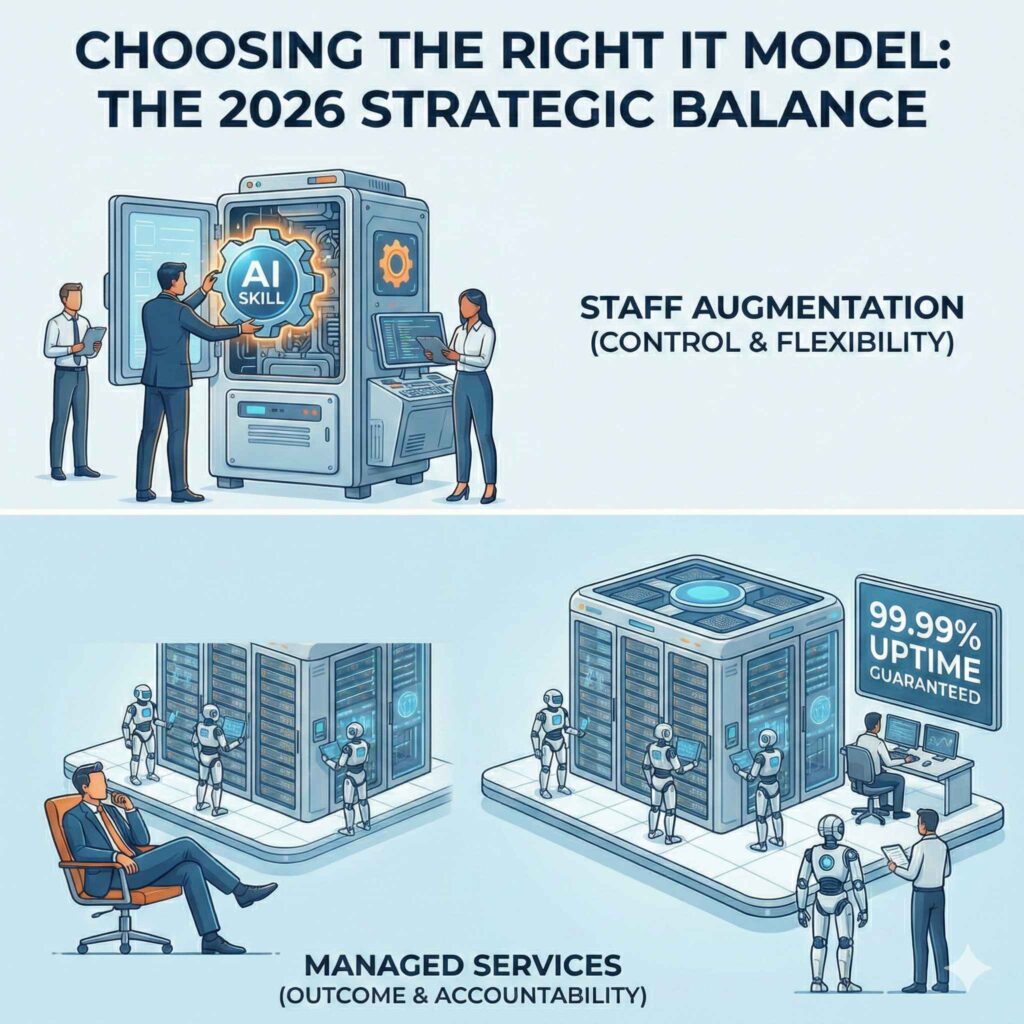
Staff Augmentation or Managed Services? How to Choose the Right Approach

In today’s fast-paced digital economy, businesses constantly seek ways to scale their IT capabilities, access specialized expertise, and deliver projects faster. Two popular outsourcing models that help organizations achieve these goals are staff augmentation and managed services.
While both approaches allow companies to leverage external talent and resources, they differ significantly in terms of control, responsibility, cost structure, and long-term impact.
This article explores the differences between staff augmentation and managed services and helps you determine which model is the right fit for your organization.
Understanding Staff Augmentation
Staff augmentation is a flexible outsourcing model where businesses temporarily hire external professionals to work alongside their in-house team.
Instead of recruiting full-time employees, companies can bring in skilled specialists—such as developers, cloud engineers, cybersecurity experts, or data analysts—for a specific project or time period.
Key Characteristics of Staff Augmentation
- Direct control: The augmented staff works under your management and follows your processes.
- Temporary engagement: Professionals are hired for a defined period or project.
- Skill-based hiring: Ideal for filling specific skill gaps.
- Quick scalability: Teams can expand or shrink depending on project needs.
When Staff Augmentation Works Best
Staff augmentation is ideal when:
- You already have a strong internal IT team but need additional expertise.
- Your company requires short-term support for specific projects.
- You want full control over project management and workflow.
- Hiring permanent employees is too time-consuming or costly.
For example, if a company is launching a new application but lacks experienced cloud architects or DevOps engineers, staff augmentation can quickly fill the gap without long-term hiring commitments.
Understanding Managed Services
Managed services involve outsourcing an entire function, project, or process to a third-party provider who takes full responsibility for delivering results.
Instead of managing individual professionals, businesses rely on a managed service provider (MSP) to handle operations, infrastructure, or development services.
Key Characteristics of Managed Services
- Outcome-based delivery: The provider is responsible for achieving defined results.
- Reduced internal workload: The MSP manages teams, processes, and technology.
- Long-term partnership: Typically structured as ongoing service agreements.
- Predictable costs: Often billed through subscription or fixed monthly fees.
When Managed Services Works Best
Managed services are most effective when:
- Your organization lacks the internal expertise or resources to manage a function.
- You want to focus on core business operations rather than IT management.
- Long-term operational efficiency and reliability are priorities.
- You need 24/7 monitoring and support, such as IT infrastructure or cybersecurity.
For instance, many companies outsource IT infrastructure management, cloud operations, or cybersecurity monitoring to managed service providers to ensure consistent performance and reduce operational complexity.
Key Differences Between Staff Augmentation and Managed Services
| Factor | Staff Augmentation | Managed Services |
|---|---|---|
| Control | Full control remains with the company | Provider manages operations |
| Responsibility | Internal team manages project | Vendor responsible for outcomes |
| Engagement model | Short-term or project-based | Long-term service agreements |
| Cost structure | Pay for talent/time | Fixed or subscription pricing |
| Management effort | High internal involvement | Minimal internal management |
Advantages of Staff Augmentation
- Greater control over projects and workflows
- Access to specialized expertise quickly
- Flexible scaling of teams
- Cost savings compared to full-time hiring
However, staff augmentation still requires strong internal project management and leadership.
Advantages of Managed Services
- Reduced operational burden
- Access to experienced teams and infrastructure
- Predictable and optimized costs
- Improved service reliability and performance
Managed services allow organizations to focus on strategic priorities instead of day-to-day IT operations.
How to Choose the Right Approach
Choosing between staff augmentation and managed services depends on several factors:
1. Internal Expertise
If your company has a strong internal IT team but needs additional support, staff augmentation is usually the better choice.
If you lack specialized expertise, managed services can provide a complete solution.
2. Project Scope
For short-term projects or temporary skill gaps, staff augmentation works best.
For ongoing operations, managed services are more efficient.
3. Level of Control
If maintaining direct control over development and operations is important, staff augmentation is preferable.
If you prefer a hands-off approach, managed services may be more suitable.
4. Budget and Cost Predictability
Managed services often offer predictable pricing, while staff augmentation may vary depending on talent and project duration.
Can Businesses Use Both Models?
Yes. Many organizations adopt a hybrid approach that combines staff augmentation and managed services.
For example:
- Use managed services for infrastructure management.
- Use staff augmentation for software development projects.
This strategy allows companies to balance flexibility, control, and operational efficiency.
Final Thoughts
Both staff augmentation and managed services provide powerful ways to scale IT capabilities and accelerate business growth. The right choice depends on your company’s internal resources, project requirements, and long-term strategy.
If you need short-term expertise and direct control, staff augmentation is the ideal solution.
If you prefer outsourcing responsibility and ensuring predictable outcomes, managed services offer a more comprehensive approach.
Understanding these differences will help your organization choose the model that best supports your technology goals and business growth.